


Page 11 - Read Online
P. 11
Han et al. J Mater Inf 2023;3:24  https://dx.doi.org/10.20517/jmi.2023.32        Page 5 of 11


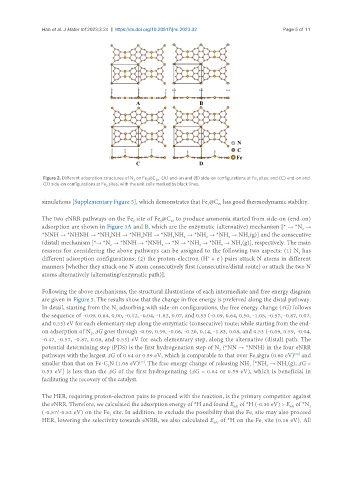
                Figure 2. Different adsorption structures of N  on Fe @C : (A) end-on and (B) side-on configurations at Fe  sites; and (C) end-on and
                                              2    3  20                                1
                (D) side-on configurations at Fe  sites, with the unit cells marked by black lines.
                                     2
               simulations [Supplementary Figure 5], which demonstrates that Fe @C  has good thermodynamic stability.
                                                                       3
                                                                           20
               The two eNRR pathways on the Fe  site of Fe @C  to produce ammonia started from side-on (end-on)
                                                       3
                                                           20
                                              2
               adsorption are shown in Figure 3A and B, which are the enzymatic (alternative) mechanism [* → *N  →
                                                                                                       2
               *NNH → *NHNH → *NH NH → *NH NH → *NH NH  → *NH  → *NH  → NH (g)] and the consecutive
                                      2
                                                 2
                                                                                     3
                                                                       2
                                                                              3
                                                           2
                                                               2
               (distal) mechanism [*→ *N  → *NNH → *NNH  → *N → *NH  → *NH  → NH (g)], respectively. The main
                                                                                  3
                                                                    2
                                                        2
                                      2
                                                                            3
               reasons for considering the above pathways can be assigned to the following two aspects: (1) N  has
                                                                                                      2
                                                                       +
                                                                           -
               different adsorption configurations; (2) the proton-electron (H  + e ) pairs attack N atoms in different
               manners [whether they attack one N atom consecutively first (consecutive/distal route) or attack the two N
               atoms alternatively (alternating/enzymatic path)].
               Following the above mechanisms, the structural illustrations of each intermediate and free energy diagram
               are given in Figure 3. The results show that the change in free energy is preferred along the distal pathway.
               In detail, starting from the N  adsorbing with side-on configurations, the free energy change (ΔG) follows
                                        2
               the sequence of -0.09, 0.64, 0.00, -0.12, -0.04, -1.82, 0.07, and 0.53 (-0.09, 0.64, 0.50, -1.05, -0.57, -0.87, 0.07,
               and 0.53) eV for each elementary step along the enzymatic (consecutive) route; while starting from the end-
               on adsorption of N , ΔG goes through -0.09, 0.59, -0.06, -0.20, 0.14, -1.83, 0.08, and 0.53 (-0.09, 0.59, -0.04,
                                2
               -0.47, -0.57, -0.87, 0.08, and 0.53) eV for each elementary step, along the alternative (distal) path. The
               potential determining step (PDS) is the first hydrogenation step of N  (*NN → *NNH) in the four eNRR
                                                                           2
                                                                                                    [58]
               pathways with the largest ΔG of 0.64 or 0.59 eV, which is comparable to that over Fe @gra (0.60 eV)  and
                                                                                       3
                                                [22]
               smaller than that on Fe-C N (1.06 eV) . The free energy change of releasing NH  [*NH  → NH (g), ΔG =
                                                                                                  3
                                     2
                                                                                     3
                                                                                           3
               0.53 eV] is less than the ΔG of the first hydrogenating (ΔG = 0.64 or 0.59 eV), which is beneficial in
               facilitating the recovery of the catalyst.
               The HER, requiring proton-electron pairs to proceed with the reaction, is the primary competitor against
               the eNRR. Therefore, we calculated the adsorption energy of *H and found E  of *H (-0.30 eV) > E  of *N
                                                                                                         2
                                                                                ads
                                                                                                   ads
               (-0.57/-0.52 eV) on the Fe  site. In addition, to exclude the possibility that the Fe  site may also proceed
                                      2
                                                                                      1
               HER, lowering the selectivity towards eNRR, we also calculated E  of *H on the Fe  site (0.16 eV). All
                                                                                         1
                                                                         ads

