


Page 28 - Read Online
P. 28
He et al. Intell. Robot. 2025, 5(2), 313-32  I http://dx.doi.org/10.20517/ir.2025.16  Page 327

                                     Table 6. Impact of LFEM, MSA, GFEM, and GLFM on RAF-DB dataset

                                            LFEM  MSA   GFEM  GLFM  Accuracy (%)
                                             √
                                                                       85.72
                                                         √
                                                                       86.83
                                             √     √
                                                                       88.82
                                             √     √     √
                                                                       89.18
                                             √     √     √     √
                                                                       90.06
                                             LFEM: Local feature extraction module; GFEM:
                                             global feature extraction module; GLFM: global-
                                             local feature fusion mod-ule; MSA: multi-scale
                                             attention.
                                              Table 7. Impact of different fusion methods

                                                    Methods  Accuracy (%)
                                                      Add      89.18
                                                     Concat    88.95
                                                    Maximum    89.02
                                                     GLFM      90.06
                                                     The  bold  format is
                                                     used to indicate the
                                                     best  (highest) accuracy.
                                                     GLFM: Global-local
                                                     feature fusion module.


                                            Table 8. Impact of different attention mechanisms
                                                    Methods  Accuracy (%)
                                                     SE  [63]  88.20
                                                    CBAM  [64]  88.23
                                                    ECA  [65]  88.07
                                                     MSA       88.82

                                                     The bold format is
                                                     used to indicate the
                                                     best (highest) accu-racy.
                                                     SE: Squeeze-and-
                                                     Excitation;
                                                     CBAM: convolutional
                                                     block attention mod-ule;
                                                     ECA:  efficient channel
                                                     attention; MSA: multi-
                                                     scale at-tention.


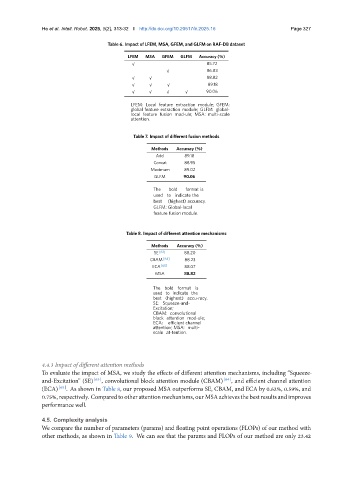
               4.4.3 Impact of different attention methods
               To evaluate the impact of MSA, we study the effects of different attention mechanisms, including “Squeeze-
               and-Excitation” (SE) [63] , convolutional block attention module (CBAM) [64] , and efficient channel attention
               (ECA) [65] . As shown in Table 8, our proposed MSA outperforms SE, CBAM, and ECA by 0.62%, 0.59%, and
               0.75%, respectively. Comparedtootherattentionmechanisms, ourMSAachievesthebestresultsandimproves
               performance well.


               4.5. Complexity analysis
               We compare the number of parameters (params) and floating point operations (FLOPs) of our method with
               other methods, as shown in Table 9. We can see that the params and FLOPs of our method are only 23.42

