


Page 27 - Read Online
P. 27
Page 326                        He et al. Intell. Robot. 2025, 5(2), 313-32  I http://dx.doi.org/10.20517/ir.2025.16

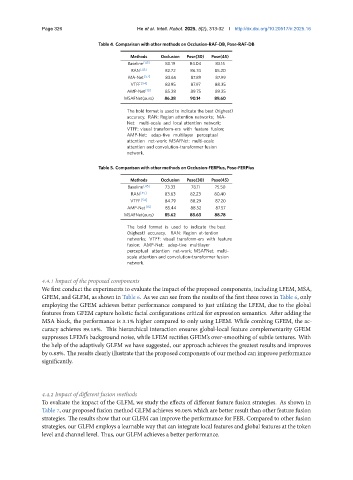
                                  Table 4. Comparison with other methods on Occlusion-RAF-DB, Pose-RAF-DB

                                             Methods   Occlusion  Pose(30)  Pose(45)
                                            Baseline  [45]  80.19  84.04  83.15
                                             RAN  [45]   82.72   86.74   85.20
                                            MA-Net  [52]  83.65  87.89    87.99
                                             VTFF  [54]  83.95   87.97    88.35
                                            AMP-Net  [15]  85.28  89.75   89.25
                                           MSAFNet(ours)  86.38  90.14   89.60

                                            The bold format is used to indicate the best (highest)
                                            accuracy. RAN: Region attention networks; MA-
                                            Net: multi-scale and local attention network;
                                            VTFF: visual transform-ers with feature fusion;
                                            AMP-Net: adap-tive multilayer perceptual
                                            attention net-work; MSAFNet: multi-scale
                                            attention and convolution-transformer fusion
                                            network.

                                  Table 5. Comparison with other methods on Occlusion-FERPlus, Pose-FERPlus

                                             Methods   Occlusion  Pose(30)  Pose(45)
                                            Baseline  [45]  73.33  78.11  75.50
                                             RAN  [45]   83.63   82.23   80.40
                                             VTFF  [54]  84.79   88.29    87.20
                                            AMP-Net  [15]  85.44  88.52   87.57
                                           MSAFNet(ours)  85.62  88.63   88.78
                                            The bold format is used to indicate the best
                                            (highest) accuracy. RAN: Region at-tention
                                            networks; VTFF: visual transform-ers with feature
                                            fusion; AMP-Net: adap-tive multilayer
                                            perceptual attention net-work; MSAFNet: multi-
                                            scale attention and convolution-transformer fusion
                                            network.

               4.4.1 Impact of the proposed components
               We first conduct the experiments to evaluate the impact of the proposed components, including LFEM, MSA,
               GFEM, and GLFM, as shown in Table 6. As we can see from the results of the first three rows in Table 6, only
               employing the GFEM achieves better performance compared to just utilizing the LFEM, due to the global
               features from GFEM capture holistic facial configurations critical for expression semantics. After adding the
               MSA block, the performance is 3.1% higher compared to only using LFEM. While combing GFEM, the ac-
               curacy achieves 89.18%. This hierarchical interaction ensures global-local feature complementarity GFEM
               suppresses LFEM’s background noise, while LFEM rectifies GFEM’s over-smoothing of subtle textures. With
               the help of the adaptively GLFM we have suggested, our approach achieves the greatest results and improves
               by 0.88%. The results clearly illustrate that the proposed components of our method can improve performance
               significantly.


               4.4.2 Impact of different fusion methods
               To evaluate the impact of the GLFM, we study the effects of different feature fusion strategies. As shown in
               Table 7, our proposed fusion method GLFM achieves 90.06% which are better result than other feature fusion
               strategies. The results show that our GLFM can improve the performance for FER. Compared to other fusion
               strategies, our GLFM employs a learnable way that can integrate local features and global features at the token
               level and channel level. Thus, our GLFM achieves a better performance.

