


Page 71 - Read Online
P. 71
Page 110                         Yang et al. Intell Robot 2024;4(1):107-24  I http://dx.doi.org/10.20517/ir.2024.07

                 Support Force Optimization
                              The demodulation step
                                                     J(· )
                                 ξ(k)  High-pass

                       −                                              Energy cost, Stepping length
                                        Filter
                                               Walking Energy Efficiency
                             cos(    )
                                                               Human-Exoskeleton-Walker System
                    The modulation step
                    ∆  (  )          Stepper               +    cos(        )
                                     Motor
                                                                                                         and
                      −     sin(    )
                 Coordinated Motion Planning  The joint angles of the wheel      Joint angles for exoskeletons
                         Motion Planning


                                                   Kinematic
                                                   Computation
                     Reference trajectory of COM


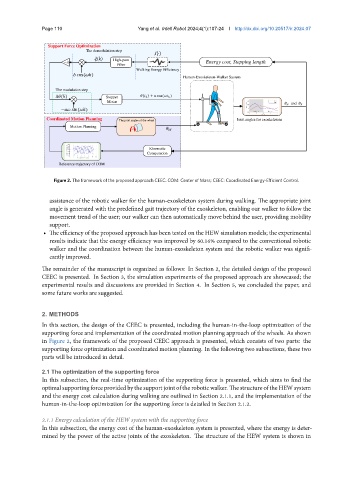
                   Figure 2. The framework of the proposed approach CEEC. COM: Center of Mass; CEEC: Coordinated Energy-Efficient Control.

                  assistance of the robotic walker for the human-exoskeleton system during walking. The appropriate joint
                  angle is generated with the predefined gait trajectory of the exoskeleton, enabling our walker to follow the
                  movement trend of the user; our walker can then automatically move behind the user, providing mobility
                  support.
                • The efficiency of the proposed approach has been tested on the HEW simulation models; the experimental
                  results indicate that the energy efficiency was improved by 60.16% compared to the conventional robotic
                  walker and the coordination between the human-exoskeleton system and the robotic walker was signifi-
                  cantly improved.

               The remainder of the manuscript is organized as follows: In Section 2, the detailed design of the proposed
               CEEC is presented. In Section 3, the simulation experiments of the proposed approach are showcased; the
               experimental results and discussions are provided in Section 4. In Section 5, we concluded the paper, and
               some future works are suggested.


               2. METHODS
               In this section, the design of the CEEC is presented, including the human-in-the-loop optimization of the
               supporting force and implementation of the coordinated motion planning approach of the wheels. As shown
               in Figure 2, the framework of the proposed CEEC approach is presented, which consists of two parts: the
               supporting force optimization and coordinated motion planning. In the following two subsections, these two
               parts will be introduced in detail.


               2.1 The optimization of the supporting force
               In this subsection, the real-time optimization of the supporting force is presented, which aims to find the
               optimal supporting force provided by the support joint of the robotic walker. The structure of the HEW system
               and the energy cost calculation during walking are outlined in Section 2.1.1, and the implementation of the
               human-in-the-loop optimization for the supporting force is detailed in Section 2.1.2.


               2.1.1 Energy calculation of the HEW system with the supporting force
               In this subsection, the energy cost of the human-exoskeleton system is presented, where the energy is deter-
               mined by the power of the active joints of the exoskeleton. The structure of the HEW system is shown in

