


Page 40 - Read Online
P. 40
Review  |  Open Access

                                        Hepatoma Research


                                       Hall et al. Hepatoma Res. 2026;12:20      DOI:10.20517/2394-5079.2025.70


               Yttrium-90 combination therapies in hepatocellular
               carcinoma: current evidence and future directions


               Bailey Hall, Zachary Ohs, Mario Dervishi, Alex Stevens, Christopher Sutter, Jon Davidson

               Keywords:
               Yttrium-90,
               radioembolization,
               hepatocellular carcinoma,
               systemic therapy,
               multi-kinase inhibitors,
               immune checkpoint
               inhibitors, combination
               therapy
               Citation: Hall B, Ohs Z,
               Dervishi M, Stevens A,
               Sutter C, Davidson J.
               Yttrium-90 combination
               therapies in hepatocellular
               carcinoma: current evidence
               and future directions.
               Hepatoma Res. 2026;12:20.
               https://dx.doi.org/10.20517
               /2394-5079.2025.70  Abstract
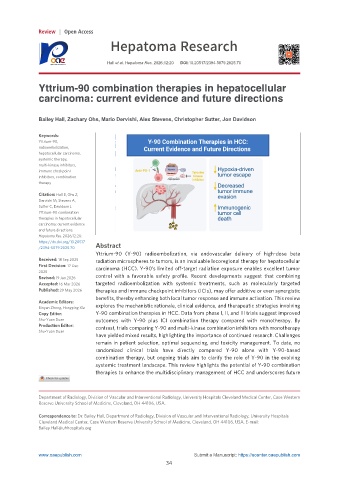
                                   Yttrium-90   (Y-90)   radioembolization,   via   endovascular   delivery   of   high-dose   beta
               Received: 18 Sep 2025  radiation microspheres to tumors, is an invaluable locoregional therapy for hepatocellular
               First Decision: 17 Dec  carcinoma (HCC). Y-90’s limited off-target radiation exposure enables excellent tumor
               2025
               Revised: 19 Jan 2026  control   with   a   favorable   safety   profile.   Recent   developments   suggest   that   combining
               Accepted: 16 Mar 2026  targeted   radioembolization   with   systemic   treatments,   such   as   molecularly   targeted
               Published: 29 May 2026  therapies and immune checkpoint inhibitors (ICIs), may offer additive or even synergistic
                                   benefits, thereby enhancing both local tumor response and immune activation. This review
               Academic Editors:
               Binyan Zhong, Hongping Xia  explores the mechanistic rationale, clinical evidence, and therapeutic strategies involving
               Copy Editor:        Y-90 combination therapies in HCC. Data from phase I, II, and III trials suggest improved
               Shu-Yuan Duan       outcomes   with   Y-90   plus   ICI   combination   therapy   compared   with   monotherapy.   By
               Production Editor:  contrast, trials comparing Y-90 and multi-kinase combination inhibitors with monotherapy
               Shu-Yuan Duan
                                   have yielded mixed results, highlighting the importance of continued research. Challenges
                                   remain  in  patient  selection,  optimal  sequencing,  and  toxicity  management.  To  date,  no
                                   randomized   clinical   trials   have   directly   compared   Y-90   alone   with   Y-90-based
                                   combination  therapy,  but  ongoing  trials  aim  to  clarify  the  role  of  Y-90  in  the  evolving
                                   systemic treatment landscape. This review highlights the potential of Y-90 combination
                                   therapies to enhance the multidisciplinary management of HCC and underscores future


               Department of Radiology, Division of Vascular and Interventional Radiology, University Hospitals Cleveland Medical Center, Case Western
               Reserve University School of Medicine, Cleveland, OH 44106, USA.

               Correspondence to: Dr. Bailey Hall, Department of Radiology, Division of Vascular and Interventional Radiology, University Hospitals
               Cleveland Medical Center, Case Western Reserve University School of Medicine, Cleveland, OH 44106, USA. E-mail:
               Bailey.Hall@uhhospitals.org


               www.oaepublish.com                                    Submit a Manuscript: https://ucenter.oaepublish.com

