


Page 42 - Read Online
P. 42
Hall et al. Hepatoma Res. 2026;12:20                                              Page 3 of 15


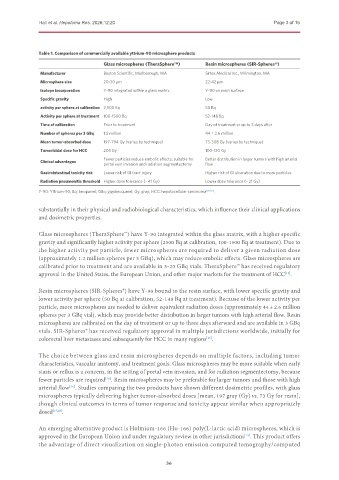
               Table 1. Comparison of commercially available yttrium-90 microsphere products
                                     Glass microspheres (TheraSphere )   Resin microspheres (SIR-Spheres®)
                                                              TM
               Manufacturer          Boston Scientific, Marlborough, MA  Sirtex Medical Inc., Wilmington, MA
               Microsphere size      20-30 μm                            22-42 μm
               Isotope incorporation  Y-90 integrated within a glass matrix  Y-90 on resin surface
               Specific gravity      High                                Low
               activity per sphere at calibration 2,500 Bq               50 Bq
               Activity per sphere at treatment 100-1500 Bq              52-148 Bq
               Time of calibration   Prior to treatment                  Day of treatment or up to 3 days after
               Number of spheres per 3 GBq  1.2 million                  44 ± 2.6 million
               Mean tumor-absorbed dose  197-794 Gy (varies by technique)  73-308 Gy (varies by technique)
               Tumoricidal dose for HCC  205 Gy                          100-120 Gy
                                     Fewer particles reduce embolic effects; suitable for  Better distribution in larger tumors with high arterial
               Clinical advantages
                                     portal vein invasion and radiation segmentectomy  flow
               Gastrointestinal toxicity risk  Lower risk of GI tract injury  Higher risk of GI ulceration due to more particles
               Radiation pneumonitis threshold Higher dose tolerance (~ 41 Gy)  Lower dose tolerance (~ 21 Gy)
               Y-90: Yttrium-90; Bq: becquerel; GBq: gigabecquerel; Gy: gray; HCC: hepatocellular carcinoma [15-22] .


               substantially in their physical and radiobiological characteristics, which influence their clinical applications
               and dosimetric properties.

               Glass microspheres (TheraSphere™) have Y-90 integrated within the glass matrix, with a higher specific
               gravity and significantly higher activity per sphere (2500 Bq at calibration, 100-1500 Bq at treatment). Due to
               the higher activity per particle, fewer microspheres are required to deliver a given radiation dose
               (approximately 1.2 million spheres per 3 GBq), which may reduce embolic effects. Glass microspheres are
               calibrated prior to treatment and are available in 3-20 GBq vials. TheraSphere™ has received regulatory
               approval in the United States, the European Union, and other major markets for the treatment of HCC .
                                                                                                     [15]

               Resin microspheres (SIR-Spheres®) have Y-90 bound to the resin surface, with lower specific gravity and
               lower activity per sphere (50 Bq at calibration, 52-148 Bq at treatment). Because of the lower activity per
               particle, more microspheres are needed to deliver equivalent radiation doses (approximately 44 ± 2.6 million
               spheres per 3 GBq vial), which may provide better distribution in larger tumors with high arterial flow. Resin
               microspheres are calibrated on the day of treatment or up to three days afterward and are available in 3 GBq
               vials. SIR-Spheres® has received regulatory approval in multiple jurisdictions worldwide, initially for
               colorectal liver metastases and subsequently for HCC in many regions .
                                                                          [15]

               The choice between glass and resin microspheres depends on multiple factors, including tumor
               characteristics, vascular anatomy, and treatment goals. Glass microspheres may be more suitable when early
               stasis or reflux is a concern, in the setting of portal vein invasion, and for radiation segmentectomy, because
               fewer particles are required . Resin microspheres may be preferable for larger tumors and those with high
                                      [16]
               arterial flow . Studies comparing the two products have shown different dosimetric profiles, with glass
                         [16]
               microspheres typically delivering higher tumor-absorbed doses [mean, 197 gray (Gy) vs. 73 Gy for resin],
               though clinical outcomes in terms of tumor response and toxicity appear similar when appropriately
               dosed [17,18] .


               An emerging alternative product is Holmium-166 (Ho-166) poly(L-lactic acid) microspheres, which is
               approved in the European Union and under regulatory review in other jurisdictions . This product offers
                                                                                       [19]
               the advantage of direct visualization on single-photon emission computed tomography/computed

