


Page 47 - Read Online
P. 47
Page 8 of 15                                                     Hall et al. Hepatoma Res. 2026;12:20


               Table 2. Key clinical studies evaluating Y-90 radioembolization combined with immune checkpoint inhibitors in hepatocellular
               carcinoma

                               Study                                          Primary
               Trial ID(Year)        Population    n  Design     Intervention            Findings
                               Phase                                          endpoint
                                                                                         PFS6 of 55.6% (95% CI,
                                     Age ≥ 18 years and
               NCT03099564(2021) I   HCC with CP ≤ B7  27  Prospective  Y-90 +  PFS6 by  35.3-74.5) and OS of 27.30
                                     and ECOG ≤ 1     Single-arm  Pembrolizumab  RECIST  months (95% CI,
                                                                                         10.15-39.52)
                                     Age ≥ 21 years and  Prospective          ORR by     ORR of 30.6% (95% CI,
               NCT03033446(2021) II  HCC with CP A and  40  Single-arm  Y-90 + Nivolumab  RECIST  16.4-48.1)Most common
                                     lesion > 20 mm                                      AE: dermatologic
                                                                                         Combination therapy was
                                                                              Nivolumab
                                     Age ≥ 18 years and  Prospective                     tolerable with MTD
               NCT02837029(2021) I                 27            Y-90 + Nivolumab  MTD with
                                     HCC with CP ≤ B8  Single-arm                        established and a CBR of
                                                                              Y-90
                                                                                         82%
                                                                                         Median TTP 15.2 months
                                     Age ≥ 19 years and  Prospective  Y-90 +  TTP by     (95% CI, 6.1-not
               NCT04124991 (2022) I/II             24
                                     HCC with CP ≤ B7  Single-arm  Durvalumab  mRECIST   estimated) 2 (8.7%) grade
                                                                                         3 AE, no grade 4
               CP: Childs-Pugh score; ECOG: Eastern Cooperative Oncology Group; Y-90: yttrium-90; PFS6: 6-month progression-free survival; RECIST: Response
               Evaluation Criteria in Solid Tumors; CI: confidence interval; OS: overall survival; ORR: objective response rate; AE: adverse event; MTD: maximum
               tolerated dose; CBR: clinical benefit rate; TTP: time to progression; RECIST: modified Response Evaluation Criteria in Solid Tumors [8,37-39] .
               Y-90 plus immune checkpoint inhibitors
               Emerging clinical evidence increasingly supports the strategic combination of Y-90 radioembolization with
               ICIs to harness the synergistic potential of radiation-induced immunomodulation and immune checkpoint
               blockade. This approach leverages the localized cytotoxic effects of Y-90 to promote immunogenic cell death
               and neoantigen release, thereby priming the tumor microenvironment to respond more effectively to ICIs.


               IMbrave050 exploratory arm
               The phase III IMbrave050 trial was designed to evaluate adjuvant atezolizumab plus bevacizumab after
               curative resection or ablation [35,36] . An exploratory arm included patients treated with Y-90 before systemic
               therapy. Preliminary analyses of the Y-90 subgroup showed improved recurrence-free survival compared
               with historical controls, with no unexpected toxicities.


               Early-phase trials and case series
               Phase I and II studies and retrospective series of Y-90 combined with PD-1/PD-L1 blockade (nivolumab,
               pembrolizumab, atezolizumab) have reported ORRs of 30%-50% and mOS approaching 20 months,
               exceeding outcomes typically observed with monotherapy. Safety signals were consistent with established ICI
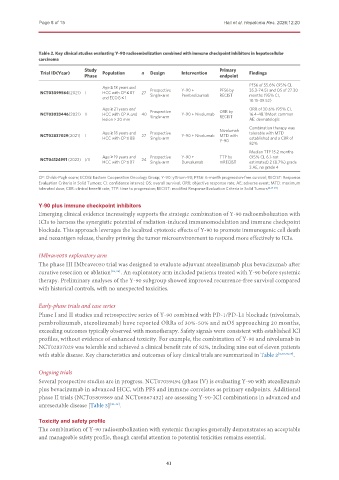
               profiles, without evidence of enhanced toxicity. For example, the combination of Y-90 and nivolumab in
               NCT02837029 was tolerable and achieved a clinical benefit rate of 82%, including nine out of eleven patients
               with stable disease. Key characteristics and outcomes of key clinical trials are summarized in Table 2 [8,37,38,39] .

               Ongoing trials
               Several prospective studies are in progress. NCT07059494 (phase IV) is evaluating Y-90 with atezolizumab
               plus bevacizumab in advanced HCC, with PFS and immune correlates as primary endpoints. Additional
               phase II trials (NCT05809869 and NCT06867432) are assessing Y-90-ICI combinations in advanced and
               unresectable disease [Table 3] [40-42] .


               Toxicity and safety profile
               The combination of Y-90 radioembolization with systemic therapies generally demonstrates an acceptable
               and manageable safety profile, though careful attention to potential toxicities remains essential.

