


Page 36 - Read Online
P. 36
Page 36             Chakraborty et al. Extracell Vesicles Circ Nucleic Acids 2023;4:27-43  https://dx.doi.org/10.20517/evcna.2023.05


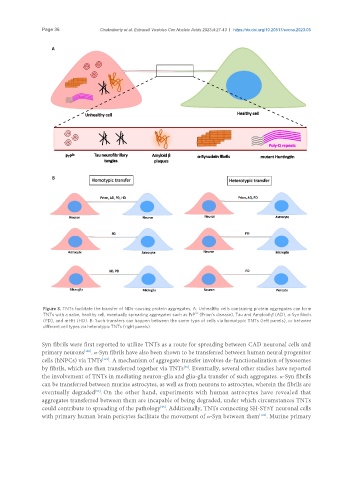
                Figure 3. TNTs facilitate the transfer of NDs-causing protein aggregates. A: Unhealthy cells containing protein aggregates can form
                                                                   Sc
                TNTs with a naïve, healthy cell, eventually spreading aggregates such as PrP  (Prion’s disease), Tau and Amyloid-β (AD), α-Syn fibrils
                (PD), and mHtt (HD). B: Such transfers can happen between the same type of cells via homotypic TNTs (left panels), or between
                different cell types via heterotypic TNTs (right panels).

               Syn fibrils were first reported to utilize TNTs as a route for spreading between CAD neuronal cells and
               primary neurons . α-Syn fibrils have also been shown to be transferred between human neural progenitor
                             [120]
               cells (hNPCs) via TNTs . A mechanism of aggregate transfer involves de-functionalization of lysosomes
                                   [121]
               by fibrils, which are then transferred together via TNTs . Eventually, several other studies have reported
                                                               [70]
               the involvement of TNTs in mediating neuron-glia and glia-glia transfer of such aggregates. α-Syn fibrils
               can be transferred between murine astrocytes, as well as from neurons to astrocytes, wherein the fibrils are
                                 [69]
               eventually degraded . On the other hand, experiments with human astrocytes have revealed that
               aggregates transferred between them are incapable of being degraded, under which circumstances TNTs
                                                       [95]
               could contribute to spreading of the pathology . Additionally, TNTs connecting SH-SY5Y neuronal cells
                                                                                        [122]
               with primary human brain pericytes facilitate the movement of α-Syn between them . Murine primary

