


Page 32 - Read Online
P. 32
Page 32                              Chakraborty et al. Extracell Vesicles Circ Nucleic Acids 2023;4:27-43  https://dx.doi.org/10.20517/evcna.2023.05


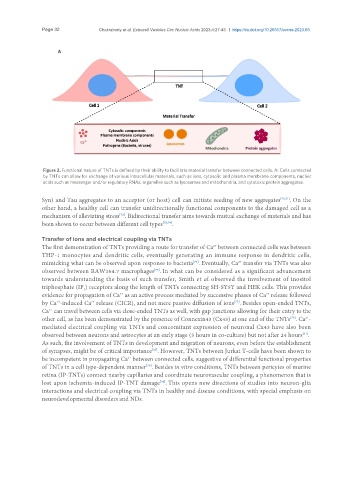
                Figure 2. Functional nature of TNTs is defined by their ability to facilitate material transfer between connected cells. A: Cells connected
                by TNTs can allow for exchange of various intracellular materials, such as ions, cytosolic and plasma membrane components, nucleic
                acids such as messenger and/or regulatory RNAs, organelles such as lysosomes and mitochondria, and cytotoxic protein aggregates.

               Syn) and Tau aggregates to an acceptor (or host) cell can initiate seeding of new aggregates [70,71] . On the
               other hand, a healthy cell can transfer unidirectionally functional components to the damaged cell as a
                                         [72]
               mechanism of alleviating stress . Bidirectional transfer aims towards mutual exchange of materials and has
               been shown to occur between different cell types [73,74] .

               Transfer of ions and electrical coupling via TNTs
               The first demonstration of TNTs providing a route for transfer of Ca  between connected cells was between
                                                                         2+
               THP-1 monocytes and dendritic cells, eventually generating an immune response in dendritic cells,
               mimicking what can be observed upon response to bacteria . Eventually, Ca  transfer via TNTs was also
                                                                                 2+
                                                                  [75]
                                                     [76]
               observed between RAW264.7 macrophages . In what can be considered as a significant advancement
               towards understanding the basis of such transfer, Smith et al. observed the involvement of inositol
               triphosphate (IP ) receptors along the length of TNTs connecting SH-SY5Y and HEK cells. This provides
                             3
               evidence for propagation of Ca  as an active process mediated by successive phases of Ca  release followed
                                         2+
                                                                                           2+
               by Ca -induced Ca  release (CICR), and not mere passive diffusion of ions . Besides open-ended TNTs,
                    2+
                                                                                [77]
                                2+
                 2+
               Ca  can travel between cells via close-ended TNTs as well, with gap junctions allowing for their entry to the
               other cell, as has been demonstrated by the presence of Connexin43 (Cx43) at one end of the TNTs . Ca -
                                                                                                        2+
                                                                                                   [78]
               mediated electrical coupling via TNTs and concomitant expression of neuronal Cx43 have also been
               observed between neurons and astrocytes at an early stage (5 hours in co-culture) but not after 24 hours .
                                                                                                       [31]
               As such, the involvement of TNTs in development and migration of neurons, even before the establishment
               of synapses, might be of critical importance . However, TNTs between Jurkat T-cells have been shown to
                                                    [29]
               be incompetent in propagating Ca  between connected cells, suggestive of differential functional properties
                                            2+
               of TNTs in a cell type-dependent manner . Besides in vitro conditions, TNTs between pericytes of murine
                                                  [79]
               retina (IP-TNTs) connect nearby capillaries and coordinate neurovascular coupling, a phenomenon that is
               lost upon ischemia-induced IP-TNT damage . This opens new directions of studies into neuron-glia
                                                       [34]
               interactions and electrical coupling via TNTs in healthy and disease conditions, with special emphasis on
               neurodevelopmental disorders and NDs.

