


Page 29 - Read Online
P. 29
Chakraborty et al. Extracell Vesicles Circ Nucleic Acids 2023;4:27-43  https://dx.doi.org/10.20517/evcna.2023.05                                  Page 29


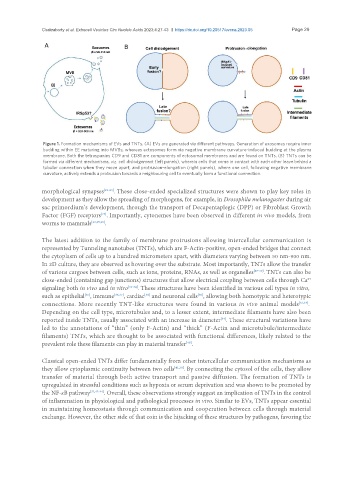
                Figure 1. Formation mechanisms of EVs and TNTs. (A) EVs are generated via different pathways. Generation of exosomes require inner
                budding within EE maturing into MVBs, whereas ectosomes form via negative membrane curvature-induced budding at the plasma
                membrane. Both the tetraspanins CD9 and CD81 are components of ectosomal membranes and are found on TNTs. (B) TNTs can be
                formed via different mechanisms, viz. cell dislodgement (left panels), wherein cells that come in contact with each other leave behind a
                tubular connection when they move apart, and protrusion-elongation (right panels), where one cell, following negative membrane
                curvature, actively extends a protrusion towards a neighbouring cell to eventually form a functional connection.


               morphological synapses [21-23] . These close-ended specialized structures were shown to play key roles in
               development as they allow the spreading of morphogens, for example, in Drosophila melanogaster during air
               sac primordium’s development, through the transport of Decapentaplegic (DPP) or Fibroblast Growth
               Factor (FGF) receptors . Importantly, cytonemes have been observed in different in vivo models, from
                                   [24]
               worms to mammals [22,25,26] .


               The latest addition to the family of membrane protrusions allowing intercellular communication is
               represented by Tunneling nanotubes (TNTs), which are F-Actin-positive, open-ended bridges that connect
               the cytoplasm of cells up to a hundred micrometers apart, with diameters varying between 50 nm-900 nm.
               In 2D culture, they are observed as hovering over the substrate. Most importantly, TNTs allow the transfer
               of various cargoes between cells, such as ions, proteins, RNAs, as well as organelles [27-30] . TNTs can also be
                                                                                                         2+
               close-ended (containing gap junctions) structures that allow electrical coupling between cells through Ca
               signaling both in vivo and in vitro [31-34] . These structures have been identified in various cell types in vitro,
                                                  [38]
                              [35]
               such as epithelial , immune [36,37] , cardiac  and neuronal cells , allowing both homotypic and heterotypic
                                                                    [30]
               connections. More recently TNT-like structures were found in various in vivo animal models [32,34] .
               Depending on the cell type, microtubules and, to a lesser extent, intermediate filaments have also been
               reported inside TNTs, usually associated with an increase in diameter . These structural variations have
                                                                           [39]
               led to the annotations of “thin” (only F-Actin) and “thick” (F-Actin and microtubule/intermediate
               filaments) TNTs, which are thought to be associated with functional differences, likely related to the
               prevalent role these filaments can play in material transfer .
                                                                [40]
               Classical open-ended TNTs differ fundamentally from other intercellular communication mechanisms as
               they allow cytoplasmic continuity between two cells [41,30] . By connecting the cytosol of the cells, they allow
               transfer of material through both active transport and passive diffusion. The formation of TNTs is
               upregulated in stressful conditions such as hypoxia or serum deprivation and was shown to be promoted by
               the NF-κB pathway [32,42-44] . Overall, these observations strongly suggest an implication of TNTs in the control
               of inflammation in physiological and pathological processes in vivo. Similar to EVs, TNTs appear essential
               in maintaining homeostasis through communication and cooperation between cells through material
               exchange. However, the other side of that coin is the hijacking of these structures by pathogens, favoring the

