


Page 35 - Read Online
P. 35
Chakraborty et al. Extracell Vesicles Circ Nucleic Acids 2023;4:27-43  https://dx.doi.org/10.20517/evcna.2023.05                                  Page 35

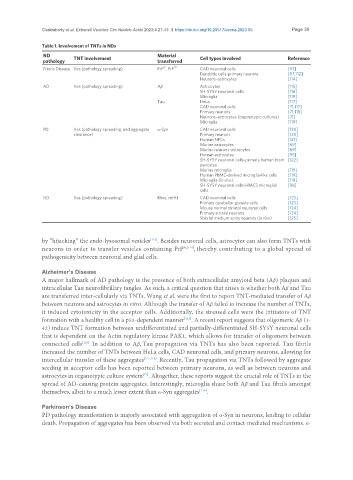
               Table 1. Involvement of TNTs in NDs
                ND        TNT involvement             Material      Cell types involved           Reference
                pathology                             transferred
                                                        C   Sc
                Prions Disease Yes (pathology spreading)  PrP , PrP  CAD neuronal cells           [97]
                                                                    Dendritic cells-primary neurons   [97,112]
                                                                    Neurons-astrocytes            [114]
                AD        Yes (pathology spreading)   Aβ            Astrocytes                    [115]
                                                                    SH-SY5Y neuronal cells        [116]
                                                                    Microglia                     [119]
                                                      Tau           HeLa                          [117]
                                                                    CAD neuronal cells            [71,117]
                                                                    Primary neurons               [71,118]
                                                                    Neurons-astrocytes (organotypic cultures)   [71]
                                                                    Microglia                     [119]
                PD        Yes (pathology spreading, and aggregate   α-Syn  CAD neuronal cells     [120]
                          clearance)                                Primary neurons               [120]
                                                                    Human NPCs                    [121]
                                                                    Murine astrocytes             [69]
                                                                    Murine neurons-astrocytes     [69]
                                                                    Human astrocytes              [95]
                                                                    SH-SY5Y neuronal cells-primary human brain  [122]
                                                                    pericytes
                                                                    Murine microglia              [119]
                                                                    Human PBMC-derived microglia-like cells   [119]
                                                                    Microglia (in vivo)           [119]
                                                                    SH-SY5Y neuronal cells-HMC3 microglial   [96]
                                                                    cells
                HD        Yes (pathology spreading)   Rhes, mHtt    CAD neuronal cells            [123]
                                                                    Primary cerebellar granule cells   [123]
                                                                    Mouse normal striatal neuronal cells   [124]
                                                                    Primary striatal neurons      [124]
                                                                    Striatal medium spiny neurons (in vivo)  [125]


               by “hijacking” the endo-lysosomal vesicles . Besides neuronal cells, astrocytes can also form TNTs with
                                                    [113]
               neurons in order to transfer vesicles containing PrP Sc[114] , thereby contributing to a global spread of
               pathogenicity between neuronal and glial cells.


               Alzheimer’s Disease
               A major hallmark of AD pathology is the presence of both extracellular amyloid beta (Aβ) plaques and
               intracellular Tau neurofibrillary tangles. As such, a critical question that arises is whether both Aβ and Tau
               are transferred inter-cellularly via TNTs. Wang et al. were the first to report TNT-mediated transfer of Aβ
               between neurons and astrocytes in vitro. Although the transfer of Aβ failed to increase the number of TNTs,
               it induced cytotoxicity in the acceptor cells. Additionally, the stressed cells were the initiators of TNT
               formation with a healthy cell in a p53-dependent manner . A recent report suggests that oligomeric Aβ (1-
                                                               [115]
               42) induce TNT formation between undifferentiated and partially-differentiated SH-SY5Y neuronal cells
               that is dependent on the Actin regulatory kinase PAK1, which allows for transfer of oligomers between
               connected cells . In addition to Aβ, Tau propagation via TNTs has also been reported. Tau fibrils
                             [116]
               increased the number of TNTs between HeLa cells, CAD neuronal cells, and primary neurons, allowing for
               intercellular transfer of these aggregates [117,118] . Recently, Tau propagation via TNTs followed by aggregate
               seeding in acceptor cells has been reported between primary neurons, as well as between neurons and
               astrocytes in organotypic culture system . Altogether, these reports suggest the crucial role of TNTs in the
                                                 [71]
               spread of AD-causing protein aggregates. Interestingly, microglia share both Aβ and Tau fibrils amongst
               themselves, albeit to a much lesser extent than α-Syn aggregates .
                                                                    [119]
               Parkinson’s Disease
               PD pathology manifestation is majorly associated with aggregation of α-Syn in neurons, leading to cellular
               death. Propagation of aggregates has been observed via both secreted and contact-mediated mechanisms. α-

