


Page 126 - Read Online
P. 126
Raposo et al. Extracell Vesicles Circ Nucleic Acids 2023;4:240-54  https://dx.doi.org/10.20517/evcna.2023.18                                     Page 246


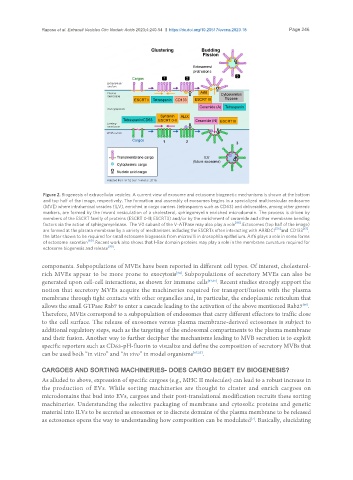
                Figure 2. Biogenesis of extracellular vesicles. A current view of exosome and ectosome biogenetic mechanisms is shown at the bottom
                and top half of the image, respectively. The formation and assembly of exosomes begins in a specialized multivesicular endosome
                (MVE) where intraluminal vesicles (ILV), enriched in cargo carriers (tetraspanins such as CD63) and deliverables, among other generic
                markers, are formed by the inward vesiculation of a cholesterol, sphingomyelin enriched microdomain. The process is driven by
                members of the ESCRT family of proteins (ESCRT 0-II; ESCRT3) and/or by the enrichment of ceramide and other membrane bending
                                                                                [98]
                factors via the action of sphingomyelinase.  The V0 subunit of the V-ATPase may also play a role  . Ectosomes (top half of the image)
                                                                                              [56]     [61]
                are formed at the plasma membrane by a variety of mechanisms including the ESCRTs often interacting with ARRDC1  and CD133  ,
                the latter shown to be required for small ectosome biogenesis from microvilli in drosophila epithelium. Arf6 plays a role in some forms
                               [60]
                of ectosome secretion  . Recent work also shows that I-Bar domain proteins may play a role in the membrane curvature required for
                                     [99]
                ectosome biogenesis and release  .
               components. Subpopulations of MVEs have been reported in different cell types. Of interest, cholesterol-
                                                            [64]
               rich MVEs appear to be more prone to exocytosis . Subpopulations of secretory MVEs can also be
               generated upon cell-cell interactions, as shown for immune cells [64,65] . Recent studies strongly support the
               notion that secretory MVEs acquire the machineries required for transport/fusion with the plasma
               membrane through tight contacts with other organelles and, in particular, the endoplasmic reticulum that
               allows the small GTPase Rab7 to enter a cascade leading to the activation of the above mentioned Rab27 .
                                                                                                       [66]
               Therefore, MVEs correspond to a subpopulation of endosomes that carry different effectors to traffic close
               to the cell surface. The release of exosomes versus plasma membrane-derived ectosomes is subject to
               additional regulatory steps, such as the targeting of the endosomal compartments to the plasma membrane
               and their fusion. Another way to further decipher the mechanisms leading to MVB secretion is to exploit
               specific reporters such as CD63-pH-fluorin to visualize and define the composition of secretory MVBs that
               can be used both “in vitro” and “in vivo” in model organisms [67,25] .

               CARGOES AND SORTING MACHINERIES- DOES CARGO BEGET EV BIOGENESIS?
               As alluded to above, expression of specific cargoes (e.g., MHC II molecules) can lead to a robust increase in
               the production of EVs. While sorting machineries are thought to cluster and enrich cargoes on
               microdomains that bud into EVs, cargoes and their post-translational modification recruits these sorting
               machineries. Understanding the selective packaging of membrane and cytosolic proteins and genetic
               material into ILVs to be secreted as exosomes or to discrete domains of the plasma membrane to be released
               as ectosomes opens the way to understanding how composition can be modulated . Basically, elucidating
                                                                                      [7]

