


Page 125 - Read Online
P. 125
Page 245                                 Raposo et al. Extracell Vesicles Circ Nucleic Acids 2023;4:240-54  https://dx.doi.org/10.20517/evcna.2023.18

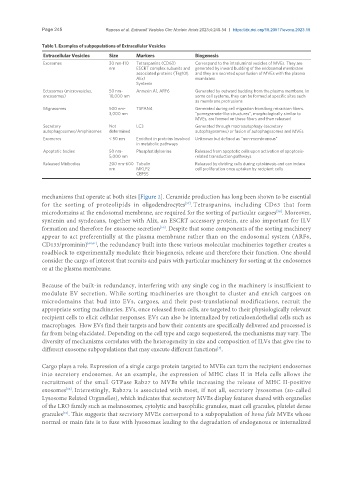
               Table 1. Examples of subpopulations of Extracellular Vesicles
                Extracellular Vesicles  Size   Markers             Biogenesis
                Exosomes              30 nm-110   Tetraspanins (CD63)   Correspond to the intraluminal vesicles of MVEs. They are
                                      nm       ESCRT complex subunits and  generated by inward budding of the endosomal membrane
                                               associated proteins (Tsg101,   and they are secreted upon fusion of MVEs with the plasma
                                               Alix)               membrane
                                               Syntenin
                Ectosomes (microvesicles,   50 nm-  Annexin A1, ARF6  Generated by outward budding from the plasma membane. In
                oncosomes)            10,000 nm                    some cell systems, they can be formed at specific sites such
                                                                   as membrane protrusions
                Migrasomes            500 nm-  TSPAN4              Generated during cell migration from long retraction fibers.
                                      3,000 nm                     “pomegranate-like structures”, morphologically similar to
                                                                   MVEs, are formed on these fibers and then released
                Secretory             Not      LC3                 Generated through macroautophagy (secretory
                autophagosomes/Amphisomes   determined             autophagosomes) or fusion of autophagosomes and MVEs
                Exomeres              < 50 nm  Enriched in proteins Involved   Unknown but defined as “non-membranous”
                                               in metabolic pathways
                Apoptotic bodies      50 nm-   Phosphatidylserine  Released from apoptotic cells upon activation of apoptosis-
                                      5,000 nm                     related transduction pathways
                Released Midbodies    200 nm-600  Tubulin          Released by dividing cells during cytokinesis and can induce
                                      nm       MKLP2               cell proliferation once uptaken by recipient cells
                                               CEP55


               mechanisms that operate at both sites [Figure 2]. Ceramide production has long been shown to be essential
                                                               [57]
               for  the  sorting  of  proteolipids  in  oligodendrocytes . Tetraspanins,  including  CD63  that  form
               microdomains at the endosomal membrane, are required for the sorting of particular cargoes . Moreover,
                                                                                              [58]
               syntenin and syndecans, together with Alix, an ESCRT accessory protein, are also important for ILV
               formation and therefore for exosome secretion . Despite that some components of the sorting machinery
                                                       [59]
               appear to act preferentially at the plasma membrane rather than on the endosomal system (ARF6,
               CD133/prominin) [60,61] , the redundancy built into these various molecular machineries together creates a
               roadblock to experimentally modulate their biogenesis, release and therefore their function. One should
               consider the cargo of interest that recruits and pairs with particular machinery for sorting at the endosomes
               or at the plasma membrane.

               Because of the built-in redundancy, interfering with any single cog in the machinery is insufficient to
               modulate EV secretion. While sorting machineries are thought to cluster and enrich cargoes on
               microdomains that bud into EVs, cargoes, and their post-translational modifications, recruit the
               appropriate sorting machineries. EVs, once released from cells, are targeted to their physiologically relevant
               recipient cells to elicit cellular responses. EVs can also be internalized by reticuloendothelial cells such as
               macrophages.  How EVs find their targets and how their contents are specifically delivered and processed is
               far from being elucidated. Depending on the cell type and cargo sequestered, the mechanisms may vary. The
               diversity of mechanisms correlates with the heterogeneity in size and composition of ILVs that give rise to
               different exosome subpopulations that may execute different functions .
                                                                          [7]
               Cargo plays a role. Expression of a single cargo protein targeted to MVEs can turn the recipient endosomes
               into secretory endosomes. As an example, the expression of MHC class II in Hela cells allows the
               recruitment of the small GTPase Rab27 to MVBs while increasing the release of MHC II-positive
               exosomes . Interestingly, Rab27a is associated with most, if not all, secretory lysosomes (so-called
                       [62]
               Lysosome Related Organelles), which indicates that secretory MVEs display features shared with organelles
               of the LRO family such as melanosomes, cytolytic and basophilic granules, mast cell granules, platelet dense
               granules . This suggests that secretory MVEs correspond to a subpopulation of bona fide MVEs whose
                      [63]
               normal or main fate is to fuse with lysosomes leading to the degradation of endogenous or internalized

