


Page 123 - Read Online
P. 123
Page 243                                 Raposo et al. Extracell Vesicles Circ Nucleic Acids 2023;4:240-54  https://dx.doi.org/10.20517/evcna.2023.18


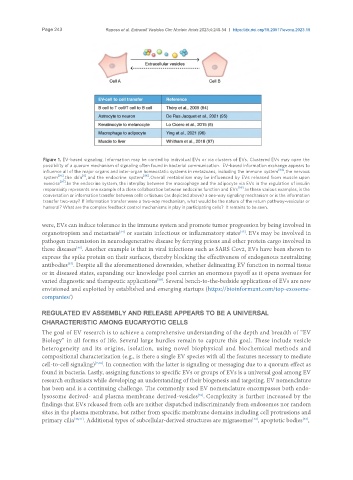
                Figure 1. EV-based signaling. Information may be carried by individual EVs or via clusters of EVs. Clustered EVs may open the
                possibility of a quorum mechanism of signaling often found in bacterial communication.  EV-based information exchange appears to
                                                                                               [94]
                influence all of the major organs and inter-organ homeostatic systems in metazoans, including the immune  system  , the nervous
                     [95]    [8]                 [96]
                system  , the  skin , and the endocrine  system  . Overall metabolism may be influenced by EVs released from muscle upon
                     [97]
                exercise  . In the endocrine system, the interplay between the macrophage and the adipocyte via EVs in the regulation of insulin
                                                                                 [96]
                responsivity represents one example of a close collaboration between endocrine function and EVs  . In these various examples, is the
                conversation or information transfer between cells or tissues (as depicted above) a one-way signaling mechanism or is the information
                transfer two-way? If information transfer were a two-way mechanism, what would be the nature of the return pathway-vesicular or
                humoral? What are the complex feedback control mechanisms in play in participating cells?  It remains to be seen.
               were, EVs can induce tolerance in the immune system and promote tumor progression by being involved in
                                         [34]
                                                                                  [35]
               organotropism and metastasis  or sustain infectious or inflammatory states . EVs may be involved in
               pathogen transmission in neurodegenerative disease by ferrying prions and other protein cargo involved in
               these diseases . Another example is that in viral infections such as SARS Cov2, EVs have been shown to
                           [36]
               express the spike protein on their surfaces, thereby blocking the effectiveness of endogenous neutralizing
                        [37]
               antibodies . Despite all the aforementioned downsides, whether delineating EV function in normal tissue
               or in diseased states, expanding our knowledge pool carries an enormous payoff as it opens avenues for
               varied diagnostic and therapeutic applications . Several bench-to-the-bedside applications of EVs are now
                                                      [38]
               envisioned and exploited by established and emerging startups (https://bioinformant.com/top-exosome-
               companies/)

               REGULATED EV ASSEMBLY AND RELEASE APPEARS TO BE A UNIVERSAL
               CHARACTERISTIC AMONG EUCARYOTIC CELLS
               The goal of EV research is to achieve a comprehensive understanding of the depth and breadth of “EV
               Biology” in all forms of life. Several large hurdles remain to capture this goal. These include vesicle
               heterogeneity  and  its  origins,  isolation,  using  novel  biophysical  and  biochemical  methods  and
               compositional characterization (e.g., is there a single EV species with all the features necessary to mediate
               cell-to-cell signaling) [7,39] . In connection with the latter is signaling or messaging due to a quorum effect as
               found in bacteria. Lastly, assigning functions to specific EVs or groups of EVs is a universal goal among EV
               research enthusiasts while developing an understanding of their biogenesis and targeting. EV nomenclature
               has been and is a continuing challenge. The commonly used EV nomenclature encompasses both endo-
                                                                    [39]
               lysosome derived- and plasma membrane derived-vesicles . Complexity is further increased by the
               findings that EVs released from cells are neither dispatched indiscriminately from endosomes nor random
               sites in the plasma membrane, but rather from specific membrane domains including cell protrusions and
                                                                                                       [43]
               primary cilia [40,41] . Additional types of subcellular-derived structures are migrasomes , apoptotic bodies ,
                                                                                      [42]

