


Page 148 - Read Online
P. 148
Martin-Gonzalez et al. Energy Mater. 2025, 5, 500121  https://dx.doi.org/10.20517/energymater.2025.32  Page 3 of 35


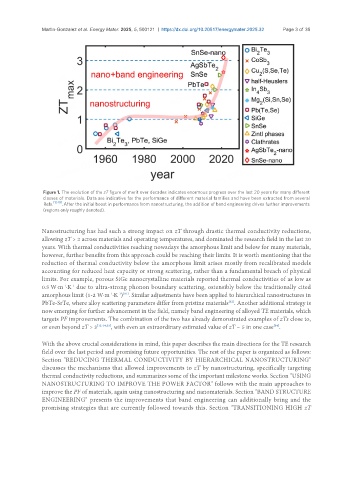
                Figure 1. The evolution of the zT figure of merit over decades indicates enormous progress over the last 20 years for many different
                classes of materials. Data are indicative for the performance of different material families and have been extracted from several
                Refs. [12-18] . After the initial boost in performance from nanostructuring, the addition of band engineering drives further improvements
                (regions only roughly denoted).


               Nanostructuring has had such a strong impact on zT through drastic thermal conductivity reductions,
               allowing zT > 2 across materials and operating temperatures, and dominated the research field in the last 20
               years. With thermal conductivities reaching nowadays the amorphous limit and below for many materials,
               however, further benefits from this approach could be reaching their limits. It is worth mentioning that the
               reduction of thermal conductivity below the amorphous limit arises mostly from recalibrated models
               accounting for reduced heat capacity or strong scattering, rather than a fundamental breach of physical
               limits. For example, porous SiGe nanocrystalline materials reported thermal conductivities of as low as
                      -1
               0.5 W·m ·K  due to ultra-strong phonon boundary scattering, ostensibly below the traditionally cited
                         -1
                                         -1 [31]
                                      -1
               amorphous limit (1-2 W·m ·K ) . Similar adjustments have been applied to hierarchical nanostructures in
               PbTe-SrTe, where alloy scattering parameters differ from pristine materials . Another additional strategy is
                                                                              [32]
               now emerging for further advancement in the field, namely band engineering of alloyed TE materials, which
               targets PF improvements. The combination of the two has already demonstrated examples of zTs close to,
               or even beyond zT > 3 [12-14,33] , with even an extraordinary estimated value of zT ~ 5 in one case .
                                                                                             [34]
               With the above crucial considerations in mind, this paper describes the main directions for the TE research
               field over the last period and promising future opportunities. The rest of the paper is organized as follows:
               Section "REDUCING THERMAL CONDUCTIVITY BY HIERARCHICAL NANOSTRUCTURING"
               discusses the mechanisms that allowed improvements to zT by nanostructuring, specifically targeting
               thermal conductivity reductions, and summarizes some of the important milestone works. Section "USING
               NANOSTRUCTURING TO IMPROVE THE POWER FACTOR" follows with the main approaches to
               improve the PF of materials, again using nanostructuring and nanomaterials. Section "BAND STRUCTURE
               ENGINEERING" presents the improvements that band engineering can additionally bring and the
               promising strategies that are currently followed towards this. Section "TRANSITIONING HIGH zT

