


Page 149 - Read Online
P. 149
Page 4 of 35    Martin-Gonzalez et al. Energy Mater. 2025, 5, 500121  https://dx.doi.org/10.20517/energymater.2025.32

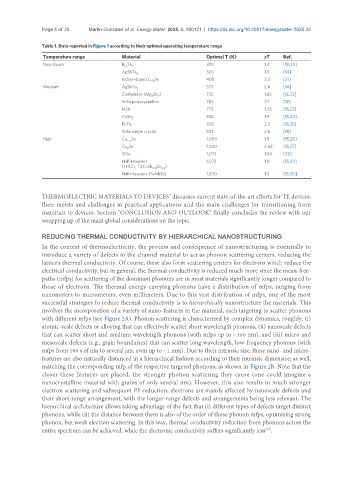
               Table 1. Data reported in Figure 1 according to their optimal operating temperature range
                Temperature range         Material                     Optimal T (K)      zT     Ref.
                Near Room                 Bi Te 3                      320                1.4    [19,20]
                                           2
                                          AgSbTe                       320                1.5    [14]
                                               2
                                          Iodine-doped Cu Se           400                2.3    [21]
                                                     2
                Medium                    AgSbTe                       573                2.6    [14]
                                               2
                                          Zintl phase (Mg Sb )         725                1.65   [15,22]
                                                      2
                                                    3
                                          SnSe polycrystalline         783                3.1    [12]
                                          InSb                         773                1.28   [15,23]
                                          CoSb 3                       835                1.9    [15,24]
                                          PbTe                         820                2.2    [15,25]
                                          SnSe single crystal          923                2.6    [18]
                High                      Cu Se                        1,000              1.5    [15,26]
                                            2-x
                                          Cu Se                        1,030              2.62   [15,27]
                                            2
                                          SiGe                         1,073              1.84   [28]
                                          Half-Heuslers                1,073              1.0    [15,29]
                                          ((Hf,Zr, Ti)CoSb Sn )
                                                    0.8  0.2
                                          Half-Heuslers (FeNbSb)       1,200              1.5    [15,30]

               THERMOELECTRIC MATERIALS TO DEVICES" discusses current state-of-the-art efforts for TE devices:
               their merits and challenges in practical applications and the main challenges for transitioning from
               materials to devices. Section "CONCLUSION AND OUTLOOK" finally concludes the review with our
               wrapping up of the main global considerations on the topic.

               REDUCING THERMAL CONDUCTIVITY BY HIERARCHICAL NANOSTRUCTURING
               In the context of thermoelectricity, the process and consequence of nanostructuring is essentially to
               introduce a variety of defects in the channel material to act as phonon scattering centers, reducing the
               lattice's thermal conductivity. Of course, these also form scattering centers for electrons which reduce the
               electrical conductivity, but in general, the thermal conductivity is reduced much more since the mean-free-
               paths (mfps) for scattering of the dominant phonons are in most materials significantly longer compared to
               those of electrons. The thermal energy-carrying phonons have a distribution of mfps, ranging from
               nanometers to micrometers, even millimeters. Due to this vast distribution of mfps, one of the most
               successful strategies to reduce thermal conductivity is to hierarchically nanostructure the materials. This
               involves the incorporation of a variety of nano-features in the material, each targeting to scatter phonons
               with different mfps (see Figure 2A). Phonon scattering is characterized by complex dynamics, roughly: (i)
               atomic-scale defects or alloying that can effectively scatter short wavelength phonons, (ii) nanoscale defects
               that can scatter short and medium wavelength phonons (with mfps up to ~100 nm), and (iii) micro and
               mesoscale defects (e.g., grain boundaries) that can scatter long wavelength, low-frequency phonons (with
               mfps from 100 s of nm to several μm, even up to ~1 mm). Due to their intrinsic size, these nano- and micro-
               features are also naturally distanced in a hierarchical fashion according to their intrinsic dimension as well,
               matching the corresponding mfp of the respective targeted phonons, as shown in Figure 2B. Note that the
               closer these features are placed, the stronger phonon scattering they cause (one could imagine a
               nanocrystalline material with grains of only several nm). However, this also results in much stronger
               electron scattering and subsequent PF reduction; electrons are mainly affected by nanoscale defects and
               their short-range arrangement, with the longer-range defects and arrangements being less relevant. The
               hierarchical architecture allows taking advantage of the fact that (i) different types of defects target distinct
               phonons, while (ii) the distance between them is also of the order of those phonon mfps, optimizing strong
               phonon, but weak electron scattering. In this way, thermal conductivity reduction from phonons across the
                                                                                          [37]
               entire spectrum can be achieved, while the electronic conductivity suffers significantly less .

