


Page 98 - Read Online
P. 98
Yang et al. Energy Mater 2023;3:300029  https://dx.doi.org/10.20517/energymater.2023.10  Page 5 of 18

               The fitting results of XPS peaks were obtained using XPSPEAK Version 4.0. In-situ differential
               electrochemical mass spectrometry (DEMS) experiments were carried out to test the CO  emission during
                                                                                           2
               charging using a commercial quadrupole mass spectrometer (Hiden Analytical) equipped with a digital
               mass flow meter (Bronkhorst). The homemade Swagelok-type cell was assembled in the glove box and then
               charged to 4.6 V at 0.2 C after resting for 3 h. Time of flight secondary ion mass spectrometry (TOF-SIMS,
               IONTOF, German) was employed to investigate the surface structure evolution of both NCM85 cathode
               and Li anode. All detected secondary ions of interest in the TOF-SIMS analysis had a mass resolution of
               over 17,000. The samples were prepared in a glove box and transferred to the instruments using an air-tight
               holder during TOF-SIMS characterizations.


               Calculation methods
               The first-principles calculations were implemented using Vienna Ab-initio Simulation Package (VASP)
                          [67]
                                                  [68]
               version 5.4.1  and Gaussian 09 package , with strongly constrained and appropriately normed (SCAN)
               and Perdew-Burke-Ernzerhof (PBE) functional, respectively. The (104) and (100) surfaces of the layered
               LiNiO  and Cubic lithium metal crystal were simulated by four-layer slab Li Ni O  and Li , respectively.
                                                                                32
                     2
                                                                                      64
                                                                                   32
                                                                                             100
                                                                                                  -4
               The plane-wave cut-off energy was set to be 520 eV, and the convergence criteria were 10  eV and
               0.05 eV Å  for electron energy and ions force, respectively, in all calculations. The structures of EC, EMC,
                       -1
                                -
                                                                                          -
               LiDFOB, and DFOB  and the corresponding redox reaction process of the EC and DFOB  were optimized at
               the B3LYP/6-311++G (d, p) level. To investigate the role of the solvent effect, the polarized continuum
               model (PCM) was performed with a dielectric constant of 20.5 (acetone) as the default solvent . The
                                                                                                    [69]
               atomic charge distributions were analyzed from natural population analysis (NPA) using the natural bond
               orbital (NBO) theory. The adsorption energy W  of molecules on the crystal surface can be acquired
                                                          ad
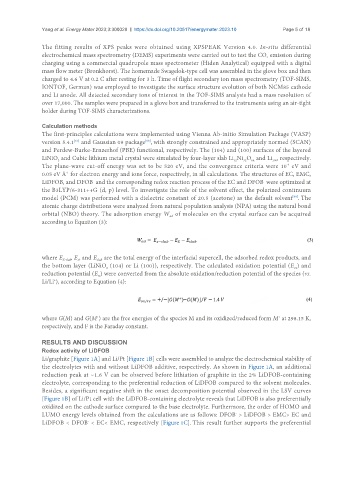
               according to Equation (3):
               where E X-slab , E , and E  are the total energy of the interfacial supercell, the adsorbed redox products, and
                           x
                                  slab
               the bottom layer (LiNiO  (104) or Li (100)), respectively. The calculated oxidation potential (E ) and
                                                                                                    ox
                                     2
               reduction potential (E ) were converted from the absolute oxidation/reduction potential of the species (vs.
                                  re
               Li/Li ), according to Equation (4):
                   +


               where G(M) and G(M ) are the free energies of the species M and its oxidized/reduced form M  at 298.15 K,
                                  +
                                                                                               +
               respectively, and F is the Faraday constant.

               RESULTS AND DISCUSSION
               Redox activity of LiDFOB
               Li/graphite [Figure 1A] and Li/Pt [Figure 1B] cells were assembled to analyze the electrochemical stability of
               the electrolytes with and without LiDFOB additive, respectively. As shown in Figure 1A, an additional
               reduction peak at ~1.6 V can be observed before lithiation of graphite in the 2% LiDFOB-containing
               electrolyte, corresponding to the preferential reduction of LiDFOB compared to the solvent molecules.
               Besides, a significant negative shift in the onset decomposition potential observed in the LSV curves
               [Figure 1B] of Li/Pt cell with the LiDFOB-containing electrolyte reveals that LiDFOB is also preferentially
               oxidized on the cathode surface compared to the base electrolyte. Furthermore, the order of HOMO and
               LUMO energy levels obtained from the calculations are as follows: DFOB  > LiDFOB > EMC> EC and
                                                                                -
                               -
               LiDFOB < DFOB  < EC< EMC, respectively [Figure 1C]. This result further supports the preferential

