


Page 97 - Read Online
P. 97
Page 4 of 18             Yang et al. Energy Mater 2023;3:300029  https://dx.doi.org/10.20517/energymater.2023.10

                                                                    -2
               use. The active material loading of the cathode was ~3 mg cm . The electrodes were separated by a single-
               layer separator (Celgard 2500) in a CR2025 coin cell filled with 100 uL electrolyte.

               Electrochemical measurement
               The fabricated cells were charged and discharged after standing for 8 h at room temperature, measured by
               the LAND system (CT2001A, Wuhan, China). For regular cycles, each Li||NCM85 battery was charged/
                                                              -1
               discharged galvanostatically at 0.3 C (1 C = 200 mAh g ) for two cycles before testing, then set the charge-
               discharge rate at 1C to analyze cyclability, voltage ranging from 3.0 V to 4.3 V/4.6 V. After two formation
               cycles at 0.2 C, the rate test was carried out at 1 C, 3 C, 5 C, 7 C, 10 C, and 0.2 C again for five cycles,
               respectively. A high current charge and discharge test was carried out to further assess the cyclic stability of
               the batteries at the charge/discharge rate of 2 C/5 C. In the galvanostatic intermittent titration test (GITT),
               the parameter pulse current was 1 C, the pulse charge/discharge time was 90 s, and the resting time was 2 h.
                                                               [64]
                     +
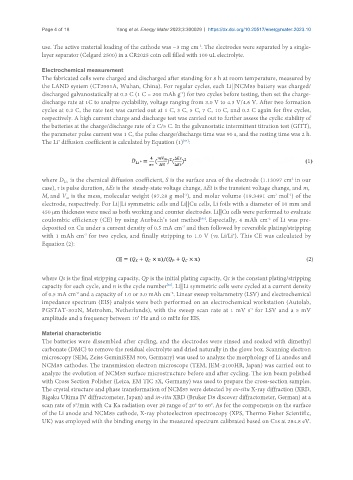
               The Li  diffusion coefficient is calculated by Equation (1) :


               where D  is the chemical diffusion coefficient, S is the surface area of the electrode (1.13097 cm  in our
                                                                                                   2
                       Li+
               case), τ is pulse duration, ΔEs is the  steady-state voltage change, ΔEt is the transient voltage change, and m,
               M, and V  is the mess, molecular weight (97.28 g mol ), and molar volume (19.3491 cm  mol ) of the
                                                               -1
                                                                                              3
                                                                                                  -1
                       m
               electrode, respectively. For Li||Li symmetric cells and Li||Cu cells, Li foils with a diameter of 10 mm and
               450 μm thickness were used as both working and counter electrodes. Li||Cu cells were performed to evaluate
               coulombic efficiency (CE) by using Aurbach’s test method . Especially, 4 mAh cm  of Li was pre-
                                                                                           -2
                                                                     [65]
               deposited on Cu under a current density of 0.5 mA cm  and then followed by reversible plating/stripping
                                                              -2
               with 1 mAh cm  for two cycles, and finally stripping to 1.0 V (vs. Li/Li ). This CE was calculated by
                                                                                +
                             -2
               Equation (2):
               where Qs is the final stripping capacity, Qp is the initial plating capacity, Qc is the constant plating/stripping
               capacity for each cycle, and n is the cycle number . Li||Li symmetric cells were cycled at a current density
                                                         [66]
                           -2
                                                           -2
               of 0.5 mA cm  and a capacity of 1.0 or 3.0 mAh cm . Linear sweep voltammetry (LSV) and electrochemical
               impedance spectrum (EIS) analysis were both performed on an electrochemical workstation (Autolab,
               PGSTAT-302N, Metrohm, Netherlands), with the sweep scan rate at 1 mV s  for LSV and a 5 mV
                                                                                     -1
               amplitude and a frequency between 10  Hz and 10 mHz for EIS.
                                               5
               Material characteristic
               The batteries were dissembled after cycling, and the electrodes were rinsed and soaked with dimethyl
               carbonate (DMC) to remove the residual electrolyte and dried naturally in the glove box. Scanning electron
               microscopy (SEM, Zeiss GeminiSEM 500, Germany) was used to analyze the morphology of Li anodes and
               NCM85 cathodes. The transmission electron microscope (TEM, JEM-2100HR, Japan) was carried out to
               analyze the evolution of NCM85 surface microstructure before and after cycling. The ion beam polished
               with Cross Section Polisher (Leica, EM TIC 3X, Germany) was used to prepare the cross-section samples.
               The crystal structure and phase transformation of NCM85 were detected by ex-situ X-ray diffraction (XRD,
               Rigaku Ultima IV diffractometer, Japan) and in-situ XRD (Bruker D8 discover diffractometer, German) at a
                           o
                                                                   o
                                                                        o
               scan rate of 5 /min with Cu Kα radiation over 2θ range of 20  to 60 . As for the components on the surface
               of the Li anode and NCM85 cathode, X-ray photoelectron spectroscopy (XPS, Thermo Fisher Scientific,
               UK) was employed with the binding energy in the measured spectrum calibrated based on C1s at 284.8 eV.

