


Page 90 - Read Online
P. 90
Kühn et al. Energy Mater 2023;3:300020  https://dx.doi.org/10.20517/energymater.2023.07  Page 11 of 14


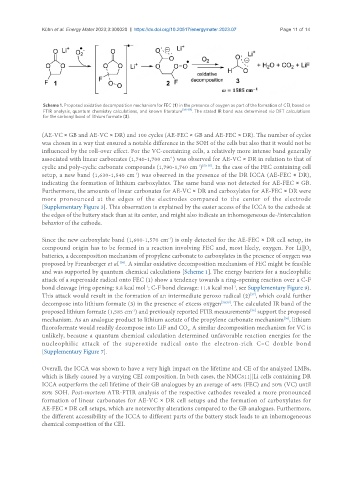
                Scheme 1. Proposed oxidative decomposition mechanism for FEC (1) in the presence of oxygen as part of the formation of CEI, based on
                FTIR analysis, quantum chemistry calculations, and known  literature [56-59] . The stated IR band was determined via DFT calculations
                for the carbonyl bond of lithium formate (3).


               (AE-VC × GB and AE-VC × DR) and 100 cycles (AE-FEC × GB and AE-FEC × DR). The number of cycles
               was chosen in a way that ensured a notable difference in the SOH of the cells but also that it would not be
               influenced by the roll-over effect. For the VC-containing cells, a relatively more intense band generally
               associated with linear carbonates (1,740-1,700 cm ) was observed for AE-VC × DR in relation to that of
                                                          -1
                                                                    -1 [53-55]
               cyclic and poly-cyclic carbonate compounds (1,790-1,740 cm )  . In the case of the FEC containing cell
               setup, a new band (1,630-1,540 cm ) was observed in the presence of the DR ICCA (AE-FEC × DR),
                                              -1
               indicating the formation of lithium carboxylates. The same band was not detected for AE-FEC × GB.
               Furthermore, the amounts of linear carbonates for AE-VC × DR and carboxylates for AE-FEC × DR were
               more  pronounced  at  the  edges  of  the  electrodes  compared  to  the  center  of  the  electrode
               [Supplementary Figure 3]. This observation is explained by the easier access of the ICCA to the cathode at
               the edges of the battery stack than at its center, and might also indicate an inhomogeneous de-/intercalation
               behavior of the cathode.


               Since the new carboxylate band (1,600-1,570 cm ) is only detected for the AE-FEC × DR cell setup, its
                                                          -1
               compound origin has to be formed in a reaction involving FEC and, most likely, oxygen. For Li||O
                                                                                                         2
               batteries, a decomposition mechanism of propylene carbonate to carboxylates in the presence of oxygen was
               proposed by Freunberger et al. . A similar oxidative decomposition mechanism of FEC might be feasible
                                         [56]
               and was supported by quantum chemical calculations [Scheme 1]. The energy barriers for a nucleophilic
               attack of a superoxide radical onto FEC (1) show a tendency towards a ring-opening reaction over a C-F
                                                  -1
               bond cleavage (ring opening: 9.8 kcal mol ; C-F bond cleavage: 11.8 kcal mol , see Supplementary Figure 9).
                                                                                -1
               This attack would result in the formation of an intermediate peroxo radical (2) , which could further
                                                                                     [57]
               decompose into lithium formate (3) in the presence of excess oxygen [58,59] . The calculated IR band of the
                                              -1
                                                                                     [56]
               proposed lithium formate (1,585 cm ) and previously reported FTIR measurements  support the proposed
                                                                                                 [56]
               mechanism. As an analogue product to lithium acetate of the propylene carbonate mechanism , lithium
               fluoroformate would readily decompose into LiF and CO . A similar decomposition mechanism for VC is
                                                                2
               unlikely, because a quantum chemical calculation determined unfavorable reaction energies for the
               nucleophilic  attack  of  the  superoxide  radical  onto  the  electron-rich  C=C  double  bond
               [Supplementary Figure 7].
               Overall, the ICCA was shown to have a very high impact on the lifetime and CE of the analyzed LMBs,
               which is likely caused by a varying CEI composition. In both cases, the NMC811||Li cells containing DR
               ICCA outperform the cell lifetime of their GB analogues by an average of 46% (FEC) and 50% (VC) until
               80% SOH. Post-mortem ATR-FTIR analysis of the respective cathodes revealed a more pronounced
               formation of linear carbonates for AE-VC  × DR cell setups and the formation of carboxylates for
               AE-FEC × DR cell setups, which are noteworthy alterations compared to the GB analogues. Furthermore,
               the different accessibility of the ICCA to different parts of the battery stack leads to an inhomogeneous
               chemical composition of the CEI.

