


Page 89 - Read Online
P. 89
Page 10 of 14            Kühn et al. Energy Mater 2023;3:300020  https://dx.doi.org/10.20517/energymater.2023.07


                                                                                   2
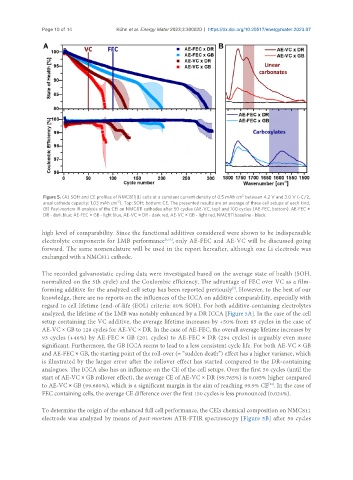
                Figure 5. (A) SOH and CE profiles of NMC811||Li cells at a constant current density of 0.5 mAh cm  between 4.2 V and 3.0 V (~C/2,
                                        -2
                areal cathode capacity: 1.03 mAh cm ). Top: SOH; bottom: CE. The presented results are an average of three cell setups of each kind.
                (B) Post-mortem IR analysis of the CEI on NMC811 cathodes after 50 cycles (AE-VC, top) and 100 cycles (AE-FEC, bottom). AE-FEC ×
                DR - dark blue; AE-FEC × GB - light blue, AE-VC × DR - dark red, AE-VC × GB - light red, NMC811 baseline - black.
               high level of comparability. Since the functional additives considered were shown to be indispensable
               electrolyte components for LMB performance [7,52] , only AE-FEC and AE-VC will be discussed going
               forward. The same nomenclature will be used in the report hereafter, although one Li electrode was
               exchanged with a NMC811 cathode.


               The recorded galvanostatic cycling data were investigated based on the average state of health (SOH,
               normalized on the 5th cycle) and the Coulombic efficiency. The advantage of FEC over VC as a film-
               forming additive for the analyzed cell setup has been reported previously . However, to the best of our
                                                                               [7]
               knowledge, there are no reports on the influences of the ICCA on additive comparability, especially with
               regard to cell lifetime (end-of-life (EOL) criteria: 80% SOH). For both additive-containing electrolytes
               analyzed, the lifetime of the LMB was notably enhanced by a DR ICCA [Figure 5A]. In the case of the cell
               setup containing the VC additive, the average lifetime increases by +50% from 85 cycles in the case of
               AE-VC × GB to 128 cycles for AE-VC × DR. In the case of AE-FEC, the overall average lifetime increases by
               93 cycles (+46%) by AE-FEC × GB (201 cycles) to AE-FEC × DR (294 cycles) is arguably even more
               significant. Furthermore, the GB ICCA seems to lead to a less consistent cycle life. For both AE-VC × GB
               and AE-FEC × GB, the starting point of the roll-over (= “sudden death”) effect has a higher variance, which
               is illustrated by the larger error after the rollover effect has started compared to the DR-containing
               analogues. The ICCA also has an influence on the CE of the cell setups. Over the first 50 cycles (until the
               start of AE-VC × GB rollover effect), the average CE of AE-VC × DR (99.765%) is 0.085% higher compared
               to AE-VC × GB (99.680%), which is a significant margin in the aim of reaching 99.9% CE . In the case of
                                                                                            [52]
               FEC containing cells, the average CE difference over the first 150 cycles is less pronounced (0.024%).


               To determine the origin of the enhanced full cell performance, the CEIs chemical composition on NMC811
               electrode was analyzed by means of post-mortem ATR-FTIR spectroscopy [Figure 5B] after 50 cycles

