


Page 70 - Read Online
P. 70
Mazzapioda et al. Energy Mater 2023;3:300019  https://dx.doi.org/10.20517/energymater.2023.03  Page 21 of 30


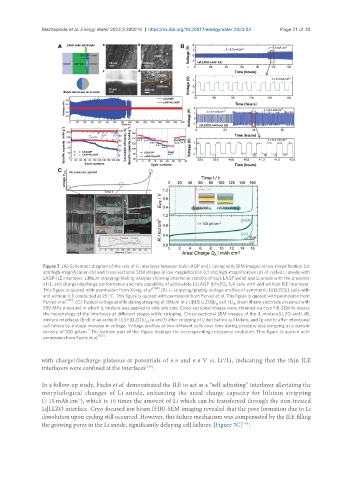
                Figure 7. (A) Schematic diagram of the role of IL interlayer between bulk LAGP and Li along with SEM images at low-magnification (a)
                and high-magnification (b) and cross sectional SEM images in low-magnification (c) and high-magnification (d) of cycled Li anode with
                LAGP-ILE interlayer. Lithium stripping/plating analysis showing interfacial stability of bulk LAGP pellet and Li anode with the presence
                of IL, and charge-discharge performance and rate capability of solid-state Li|LAGP |LiFePO  full cells with and without ILE interlayer.
                                                                             4
                This figure is quoted with permission from Xiong  et al. [148] . (B) Li stripping/plating voltage profiles of symmetric Li|LLZO|Li cells with
                and without ILE conducted at 25 °C. This figure is quoted with permission from Pervez et al. This figure is quoted with permission from
                Pervez et al. [150] . (C) Typical voltage profile during stripping of lithium in a Li|ILE|LLZO|Li  cell (Li , ideal lithium electrode prepared with
                                                                          id
                                                                                id
                380 MPa pressure) in which IL mixture was applied to only one side. Cross-sectional images were obtained via cryo FIB-SEM to assess
                the morphology of the interfaces at different stages while stripping. Cross-sectional SEM images of the IL mixture|LLZO and Li|IL
                mixture interfaces (b-d) in an as-built Li|ILE|LLZO|Li , (e and f) after stripping of Li but before cell failure, and (g and h) after intentional
                                                  id
                cell failure by a steep increase in voltage. Voltage profiles of two different cells over time during pressure less stripping at a current
                              -2
                density of 100  μAcm . The bottom part of the Figure displays the corresponding resistance evolution. This figure is quoted with
                permission from Fuchs et al. [153] .
               with charge/discharge plateaus at potentials of 6.9 and 6.8 V vs. Li /Li, indicating that the thin ILE
                                                                            +
               interlayers were confined at the interfaces .
                                                  [150]
               In a follow-up study, Fuchs et al. demonstrated the ILE to act as a “self-adjusting” interlayer alleviating the
               morphological  changes  of  Li  anode,  enhancing  the  areal  charge  capacity  for  lithium  stripping
                           -2
               (> 15 mAh cm ), which is 10 times the amount of Li which can be transferred through the non-treated
               Li|LLZO interface. Cryo-focused ion beam (FIB)-SEM imaging revealed that the pore formation due to Li
               dissolution upon cycling still occurred. However, this failure mechanism was compensated by the ILE filling
               the growing pores in the Li anode, significantly delaying cell failures. [Figure 7C] .
                                                                                   [153]

