


Page 67 - Read Online
P. 67
Page 18 of 30       Mazzapioda et al. Energy Mater 2023;3:300019  https://dx.doi.org/10.20517/energymater.2023.03

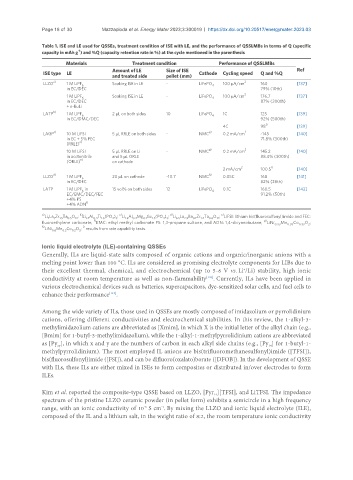
               Table 1. ISE and LE used for QSSEs, treatment condition of ISE with LE, and the performance of QSSLMBs in terms of Q (specific
                           -1
               capacity in mAh g ) and %Q (capacity retention rate in %) at the cycle mentioned in the parenthesis
                       Materials              Treatment condition          Performance of QSSLMBs
                                       Amount of LE      Size of ISE                                 Ref
                ISE type  LE                                        Cathode  Cycling speed  Q and %Q
                                       and treated side  pellet (mm)
                   a)                                                              2
                LLZO   1 M LiPF        Soaking ISE in LE  -         LiFePO  100 μA/cm    160         [137]
                             6                                           4
                       in EC/DEC                                                         79% (10th)
                                                                                   2
                       1 M LiPF        Soaking ISE in LE   -        LiFePO  100 μA/cm    176.7       [137]
                             6                                           4
                       in EC/DEC                                                         87% (200th)
                       + n-BuLi
                   b)
                LATP   1 M LiPF        2 µL on both sides  10       LiFePO 4  1C         125         [139]
                             6
                       in EC/DMC/DEC                                                     92% (500th)
                                                                                           i)
                                                                            4C           98          [139]
                LAGP c)  10 M LiFSI    5 μL RRLE on both sides  -   NMC g)  0.2 mA/cm 2  ~145        [140]
                       in EC + 5% FEC                                                    71.8% (300th)
                       (RRLE) e)
                                                                       g)           2
                       10 M LiFSI      5 μL RRLE on Li   -          NMC     0.2 mA/cm    145.2       [140]
                       in acetonitrile   and 5 μL ORLE                                   88.4% (300th)
                            e)
                       (ORLE)          on cathode
                                                                                  2         i)
                                                                            2 mA/cm      100.5       [140]
                LLZO d)  1 M LiPF      20 µL on cathode  ~10.7      NMC h)  0.05C        168         [141]
                             6
                       in EC/DEC                                                         82% (28th)
                LATP   1 M LiPF  in    15 vol% on both sides  12    LiFePO 4  0.1C       160.5       [142]
                             6
                       EC/EMC/DEC/FEC                                                    91.2% (50th)
                       +4% PS
                              f)
                       +4% ADN
               a)           b)           c)               d)                e)
                Li La Zr Ta O ;  Li Al Ti (PO ) ;  Li Al Mg Ge (PO ) ;  Li La Ba Zr Ta O ;  LiFSI: lithium bis(fluorosulfonyl)imide and FEC:
                                       4 3
                                              0.4
                                           1.6
                              1.4
                                0.4
                                   1.6
                                                 0.1
                                                                     1.4
                                                                  0.1
                                                                          12
                                                                       0.6
                                                        4 3
                                                    1.5
                                                               2.9
                                                            6.5
                        0.5
                          12
                   3
                 7
                     1.5
                                 f)
                                                                                          g)
               fluoroethylene carbonate;  EMC: ethyl methyl carbonate PS: 1,3-propane sultone, and ADN: 1,4-dicyanobutane;  LiNi 0.33 Mn 0.33 Co  0.33 O ;
                                                                                                         2
               h)            i)
                LiNi Mn Co O ;   results from rate capability tests.
                   0.6  0.2  0.2  2
               Ionic liquid electrolyte (ILE)-containing QSSEs
               Generally, ILs are liquid-state salts composed of organic cations and organic/inorganic anions with a
               melting point lower than 100 °C. ILs are considered as promising electrolyte components for LIBs due to
                                                                                   +
               their excellent thermal, chemical, and electrochemical (up to 5-6 V vs. Li /Li) stability, high ionic
               conductivity at room temperature as well as non-flammability . Currently, ILs have been applied in
                                                                       [143]
               various electrochemical devices such as batteries, supercapacitors, dye-sensitized solar cells, and fuel cells to
               enhance their performance .
                                      [144]
               Among the wide variety of ILs, those used in QSSEs are mostly composed of imidazolium or pyrrolidinium
               cations, offering different conductivities and electrochemical stabilities. In this review, the 1-alkyl-3-
               methylimidazolium cations are abbreviated as [Xmim], in which X is the initial letter of the alkyl chain (e.g.,
               [Bmim] for 1-butyl-3-methylimidazolium), while the 1-alkyl-1-methylpyrrolidinium cations are abbreviated
               as [Py ], in which x and y are the numbers of carbon in each alkyl side chains (e.g., [Py ] for 1-butyl-1-
                    xy
                                                                                            14
               methylpyrrolidinium). The most employed IL anions are bis(trifluoromethanesulfonyl)imide ([TFSI]),
               bis(fluorosulfonyl)imide ([FSI]), and can be difluoro(oxalato)borate ([DFOB]). In the development of QSSE
               with ILs, these ILs are either mixed in ISEs to form composites or distributed in/over electrodes to form
               ILEs.
               Kim et al. reported the composite-type QSSE based on LLZO, [Pyr ][TFSI], and LiTFSI. The impedance
                                                                         14
               spectrum of the pristine LLZO ceramic powder (in pellet form) exhibits a semicircle in a high frequency
                                                       -1
               range, with an ionic conductivity of 10  S cm . By mixing the LLZO and ionic liquid electrolyte (ILE),
                                                  -6
               composed of the IL and a lithium salt, in the weight ratio of 8:2, the room temperature ionic conductivity

