


Page 63 - Read Online
P. 63
Page 14 of 30       Mazzapioda et al. Energy Mater 2023;3:300019  https://dx.doi.org/10.20517/energymater.2023.03


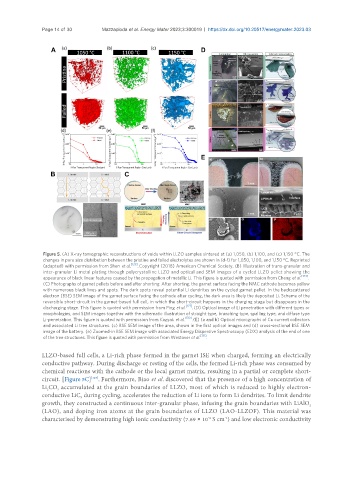
                Figure 5. (A) X-ray tomographic reconstructions of voids within LLZO samples sintered at (a) 1,050, (b) 1,100, and (c) 1,150 °C. The
                changes in pore size distribution between the pristine and failed electrolytes are shown in (d-f) for 1,050, 1,100, and 1,150 °C. Reprinted
                                             [123]
                (adapted) with permission from Shen  et al.  . Copyright (2018) American Chemical Society. (B) Illustration of trans-granular and
                inter-granular Li metal plating through polycrystalline LLZO and optical and SEM images of a cycled LLZO pellet showing the
                                                                                                       [124]
                appearance of black linear features caused by the propagation of metallic Li. This figure is quoted with permission from Cheng et al.  .
                (C) Photographs of garnet pellets before and after shorting. After shorting, the garnet surface facing the NMC cathode becomes yellow
                with numerous black lines and spots. The dark spots reveal potential Li dendrites on the cycled garnet pellet. In the backscattered
                electron (BSE) SEM image of the garnet surface facing the cathode after cycling, the dark area is likely the deposited Li. Scheme of the
                reversible short-circuit in the garnet-based full cell, in which the short-circuit happens in the charging stage but disappears in the
                                                                [127]
                discharging stage. This figure is quoted with permission from Ping et al.  . (D) Optical image of Li penetration with different types or
                morphologies, and SEM images together with the schematic illustration of straight type, branching type, spalling type, and diffuse type
                                                               [130]
                Li-penetration. This figure is quoted with permission from Kazyak et al.  . (E) (a and b) Optical micrographs of Cu current collectors
                and associated Li tree structures. (c) BSE SEM image of the area, shown in the first optical images and (d) cross-sectional BSE SEM
                image of the battery. (e) Zoomed-in BSE SEM image with associated Energy Dispersive Spectroscopy (EDX) analysis of the end of one
                of the tree structures. This figure is quoted with permission from Westover et al. [131] .

               LLZO-based full cells, a Li-rich phase formed in the garnet ISE when charged, forming an electrically
               conductive pathway. During discharge or resting of the cells, the formed Li-rich phase was consumed by
               chemical reactions with the cathode or the local garnet matrix, resulting in a partial or complete short-
                                [127]
               circuit. [Figure 5C] . Furthermore, Biao et al. discovered that the presence of a high concentration of
               Li CO  accumulated at the grain boundaries of LLZO, most of which is reduced to highly electron-
                    3
                 2
               conductive LiC  during cycling, accelerates the reduction of Li ions to form Li dendrites. To limit dendrite
                            x
               growth, they constructed a continuous inter-granular phase, infusing the grain boundaries with LiAlO
                                                                                                         2
               (LAO), and doping iron atoms at the grain boundaries of LLZO (LAO-LLZOF). This material was
                                                                             -1
               characterised by demonstrating high ionic conductivity (7.69 × 10  S cm ) and low electronic conductivity
                                                                       -4

