


Page 60 - Read Online
P. 60
Mazzapioda et al. Energy Mater 2023;3:300019  https://dx.doi.org/10.20517/energymater.2023.03  Page 11 of 30

               Physical-mechanical processes
               Apart from the chemical-electrochemical stability issues, undesirable physical-mechanical interactions at
               the Li|ISE interface also affect the performance of SSLMBs. Poor physical contact at Li|ISE solid-solid
               interface results from a poor wetting phenomenon of the ISE by Li, which can be evaluated by simple
                                                               [109]
               contact angle measurements between ISEs and molten Li . Many oxide-based ISEs present a lithiophobic
               property due to their high interfacial energy against Li, which leads to large contact angles (> 90°), reducing
               the effective Li-ion transfer area between ISEs and Li. As prepared, lithium garnet electrolytes exhibit a
               rough surface and high contact angle (ca. 146°), i.e., poor wetting, with Li. This results in inhomogeneous
               current distribution and high Li|ISE interface resistance, leading to high cell polarisation. As demonstrated
               by Sharafi et al., it is due to the presence of contaminants such as Li CO , and LiOH formed on the LLZO
                                                                          2
                                                                             3
               surface after exposure to ambient air, inducing poor Li wettability and high interfacial resistance
                           2
               (ca. 400 Ω cm ). After removing these surface contaminations via polishing, a lower contact angle (95°) and
               interfacial resistance (2 Ωcm ) were achieved [Figure 4A] .
                                                               [110]
                                       2
               Even in the absence of contamination layers, the charge transfer at the Li|ISE interface can be hindered by
               the mechanical processes that take place at the interface. Krauskopf et al. reported important insights on the
               chemo-mechanics of the Li|LLZO interface, demonstrating that at low applied pressures, charge transfer
                                                                                  [111]
               and constriction resistances are responsible for the high interfacial resistances . Constriction resistances,
               also denoted as spreading resistances, are electrical contact resistances that occur because of incomplete
               surface contact between electrical conductors and the resulting current line bundling at the small contact
               spots. Thus, negligible interfacial resistances can be obtained by applying high external pressure of about
               400 MPa. In addition, they observed a key process that takes place at the Li|LLZO interface under anodic
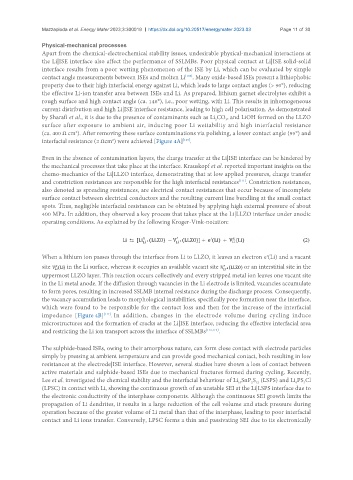
               operating conditions. As explained by the following Kroger-Vink-notation:


               When a lithium ion passes through the interface from Li to LLZO, it leaves an electron e′(Li) and a vacant
               site     in the Li surface, whereas it occupies an available vacant site    or an interstitial site in the
               uppermost LLZO layer. This reaction occurs collectively and every stripped metal ion leaves one vacant site
               in the Li metal anode. If the diffusion through vacancies in the Li electrode is limited, vacancies accumulate
               to form pores, resulting in increased SSLMB internal resistance during the discharge process. Consequently,
               the vacancy accumulation leads to morphological instabilities, specifically pore formation near the interface,
               which were found to be responsible for the contact loss and then for the increase of the interfacial
               impedance  [Figure 4B] . In  addition,  changes  in  the  electrode  volume  during  cycling  induce
                                    [111]
               microstructures and the formation of cracks at the Li|ISE interface, reducing the effective interfacial area
               and restricting the Li ion transport across the interface of SSLMBs [112,113] .

               The sulphide-based ISEs, owing to their amorphous nature, can form close contact with electrode particles
               simply by pressing at ambient temperature and can provide good mechanical contact, both resulting in low
               resistances at the electrode|ISE interface. However, several studies have shown a loss of contact between
               active materials and sulphide-based ISEs due to mechanical fractures formed during cycling. Recently,
               Lee et al. investigated the chemical stability and the interfacial behaviour of Li SnP S  (LSPS) and Li PS Cl
                                                                                      2 12
                                                                                 10
                                                                                                       5
                                                                                                     6
               (LPSC) in contact with Li, showing the continuous growth of an unstable SEI at the Li|LSPS interface due to
               the electronic conductivity of the interphase components. Although the continuous SEI growth limits the
               propagation of Li dendrites, it results in a large reduction of the cell volume and stack pressure during
               operation because of the greater volume of Li metal than that of the interphase, leading to poor interfacial
               contact and Li ions transfer. Conversely, LPSC forms a thin and passivating SEI due to its electronically

