


Page 57 - Read Online
P. 57
Page 8 of 30        Mazzapioda et al. Energy Mater 2023;3:300019  https://dx.doi.org/10.20517/energymater.2023.03


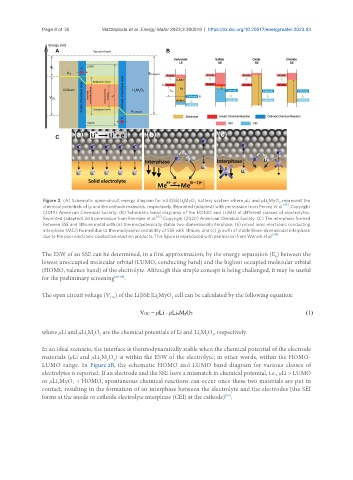
                Figure 2. (A) Schematic open-circuit energy diagram for a Li|SSE|Li MyO  battery system where μLi and μLi MyO  represent the
                                                               x   2                       x   2
                                                                                                [95]
                chemical potentials of Li and the cathode materials, respectively. Reprinted (adapted) with permission from Pervez et al.  . Copyright
                (2019) American Chemical Society. (B) Schematic band diagrams of the HOMO and LUMO of different classes of electrolytes.
                                                      [97]
                Reprinted (adapted) with permission from Banerjee et al.  . Copyright (2020) American Chemical Society. (C) The interphase formed
                between SSE and lithium metal with (a) thermodynamically stable two-dimensional interphase, (b) mixed ionic-electronic conducting
                interphase (MCI) formed due to thermodynamic instability of SSE with lithium, and (c) growth of stable three-dimensional interphase
                                                                                             [98]
                due to the poor electronic conductive reaction products. This figure is reproduced with permission from Wenzel et al.  .
               The ESW of an SSE can be determined, in a first approximation, by the energy separation (E ) between the
                                                                                              g
               lowest unoccupied molecular orbital (LUMO, conducting band) and the highest occupied molecular orbital
               (HOMO, valence band) of the electrolyte. Although this simple concept is being challenged, it may be useful
               for the preliminary screening [96-98] .

               The open circuit voltage (V ) of the Li|SSE|Li MyO  cell can be calculated by the following equation:
                                                      x
                                                           2
                                      OC


               where μLi and μLi M O  are the chemical potentials of Li and Li M O , respectively.
                                   2
                                                                         2
                                y
                                                                    x
                                                                       y
                              x
               In an ideal scenario, the interface is thermodynamically stable when the chemical potential of the electrode
               materials (μLi and μLi M O ) is within the ESW of the electrolyte; in other words, within the HOMO-
                                   x
                                     y
                                       2
               LUMO range. In Figure 2B, the schematic HOMO and LUMO band diagram for various classes of
               electrolytes is reported. If an electrode and the SSE have a mismatch in chemical potential, i.e., μLi > LUMO
               or μLi MyO  < HOMO, spontaneous chemical reactions can occur once these two materials are put in
                    x
                          2
               contact, resulting in the formation of an interphase between the electrolyte and the electrodes (the SEI
               forms at the anode or cathode electrolyte interphase (CEI) at the cathode) .
                                                                             [97]

