


Page 54 - Read Online
P. 54
Mazzapioda et al. Energy Mater 2023;3:300019  https://dx.doi.org/10.20517/energymater.2023.03  Page 5 of 30


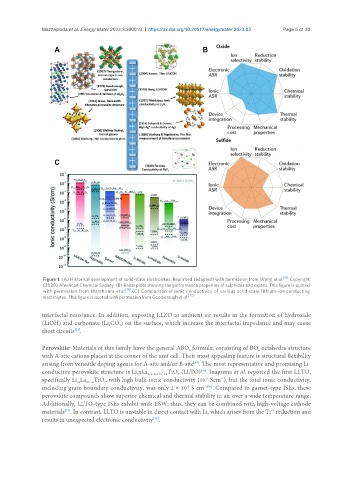
                Figure 1. (A) Historical development of solid-state electrolytes. Reprinted (adapted) with permission from Wang  et al. [41] . Copyright
                (2020) American Chemical Society. (B) Radar plots showing the performance properties of sulphides and oxides. This figure is quoted
                with permission from Manthiram  et al. [18] . (C) Comparison of ionic conductivity of various solid-state lithium-ion conducting
                electrolytes. This figure is quoted with permission from Goodenough et al. [42] .


               interfacial resistance. In addition, exposing LLZO to ambient air results in the formation of hydroxide
               (LiOH) and carbonate (Li CO ) on the surface, which increase the interfacial impedance and may cause
                                         3
                                      2
                          [53]
               short circuits .
               Perovskite: Materials of this family have the general ABO  formula, consisting of BO  octahedra structure
                                                                 3
                                                                                        6
               with A-site cations placed at the corner of the unit cell. Their most appealing feature is structural flexibility
               arising from versatile doping agents for A-site and/or B-site . The most representative and promising Li-
                                                                  [54]
               conductive perovskite structure is Li xLa 2/3-xy1/3 2x  3  [55]
                                                        - TiO  (LLTO) . Inaguma et al. reported the first LLTO,
                                               3
                                                                      -3
                                                                           -1
               specifically Li La 2/3-x TiO , with high bulk-ionic conductivity (10  Scm ), but the total ionic conductivity,
                           3x
                                    3
               including grain boundary conductivity, was only 2 × 10  S cm -1[56] . Compared to garnet-type ISEs, these
                                                                -5
               perovskite compounds show superior chemical and thermal stability in air over a wide temperature range.
               Additionally, LLTO-type ISEs exhibit wide ESW; thus, they can be combined with high-voltage cathode
               materials . In contrast, LLTO is unstable in direct contact with Li, which arises from the Ti  reduction and
                                                                                            4+
                       [57]
               results in unexpected electronic conductivity .
                                                     [58]

