


Page 61 - Read Online
P. 61
Page 12 of 30       Mazzapioda et al. Energy Mater 2023;3:300019  https://dx.doi.org/10.20517/energymater.2023.03


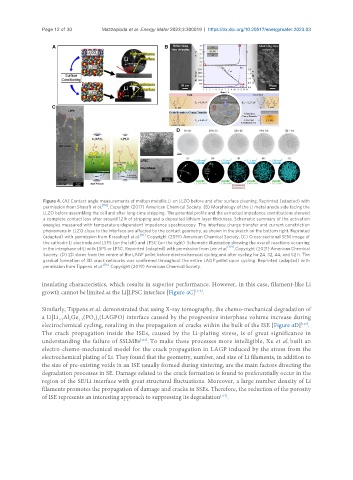
                Figure 4. (A) Contact angle measurements of molten metallic Li on LLZO before and after surface cleaning. Reprinted (adapted) with
                permission from Sharafi et al. [110] . Copyright (2017) American Chemical Society. (B) Morphology of the Li metal anode side facing the
                LLZO before assembling the cell and after long-time stripping. The potential profile and the extracted impedance contributions showed
                a complete contact loss after around 12 h of stripping and a deposited lithium layer thickness. Schematic summary of the activation
                energies measured with temperature-dependent impedance spectroscopy. The interface charge transfer and current constriction
                phenomena in LLZO close to the interface are affected by the contact geometry, as shown in the sketch on the bottom right. Reprinted
                (adapted) with permission from Krauskopf  et al. [111] . Copyright (2019) American Chemical Society. (C) Cross-sectional SEM image of
                the cathodic Li electrode and LSPS (on the left) and LPSC (on the right). Schematic illustration showing the overall reactions occurring
                in the interphase of Li with LSPS or LPSC. Reprinted (adapted) with permission from Lee et al. [114] . Copyright (2021) American Chemical
                Society. (D) 2D slices from the centre of the LAGP pellet before electrochemical cycling and after cycling for 24, 32, 44, and 52 h. The
                gradual formation of 3D crack networks was confirmed throughout the entire LAGP pellet upon cycling. Reprinted (adapted) with
                permission from Tippens et al. [115] . Copyright (2019) American Chemical Society.

               insulating characteristics, which results in superior performance. However, in this case, filament-like Li
               growth cannot be limited at the Li|LPSC interface [Figure 4C] .
                                                                   [114]
               Similarly, Tippens et al. demonstrated that using X-ray tomography, the chemo-mechanical degradation of
               a Li|Li Al Ge (PO ) (LAGPO) interface caused by the progressive interphase volume increase during
                           2-x
                                 4 3
                        x
                     1+x
                                                                                                      [115]
               electrochemical cycling, resulting in the propagation of cracks within the bulk of the ISE [Figure 4D] .
               The crack propagation inside the ISEs, caused by the Li-plating stress, is of great significance in
                                                [116]
               understanding the failure of SSLMBs . To make these processes more intelligible, Xu et al. built an
               electro-chemo-mechanical model for the crack propagation in LAGP induced by the stress from the
               electrochemical plating of Li. They found that the geometry, number, and size of Li filaments, in addition to
               the size of pre-existing voids in an ISE usually formed during sintering, are the main factors directing the
               degradation processes in SE. Damage related to the crack formation is found to preferentially occur in the
               region of the SE/Li interface with great structural fluctuations. Moreover, a large number density of Li
               filaments promotes the propagation of damage and cracks in SSEs. Therefore, the reduction of the porosity
               of ISE represents an interesting approach to suppressing its degradation .
                                                                           [117]

