


Page 69 - Read Online
P. 69
Page 20 of 30       Mazzapioda et al. Energy Mater 2023;3:300019  https://dx.doi.org/10.20517/energymater.2023.03

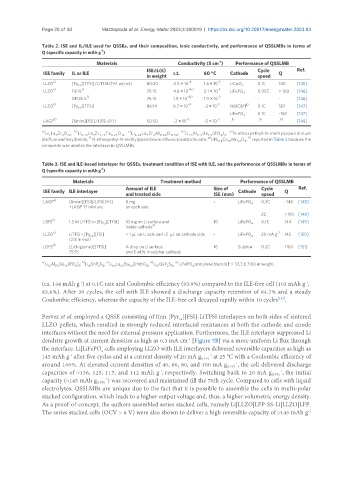
               Table 2. ISE and IL/ILE used for QSSEs, and their composition, ionic conductivity, and performance of QSSLMBs in terms of
                                   -1
               Q (specific capacity in mAh g )
                                  Materials                  Conductivity (S cm )  Performance of QSSLMB
                                                                           -1
                                                  ISE:IL(E)                             Cycle        Ref.
                ISE family  IL or ILE                      r.t.       60 °C    Cathode         Q
                                                  in weight                             speed
                   a)                                            -4       -3
                LLZO     [Py ][TFSI]/LiTFSI (19:1 wt/wt)  80:20  4.0 × 10  1.6 × 10  LiCoO  0.1C  140  [145]
                           14                                                      2
                LLZO c)  FSI IL e)                75:15    4.8 × 10 -4c)  2.1 × 10 -3  LiFePO 4  0.05C  > 100  [146]
                              f)                                -4c)       -3
                         DFOB IL                  75:15    1.9 × 10   1.0 × 10          -      -     [146]
                   b)                                           -4        -3        g)
                LLZO     [Py ][TFSI]              86:14    6.7 × 10   ~3 × 10  NMC811   0.1C   187   [147]
                           14
                                                                               LiFePO 4  0.1C  ~150  [147]
                   d)                                           -3        -3   h)       h)      h)
                LAGP     [Bmim][FSI]/LiFSI (9:1)  50:50    ~2 × 10    ~5 × 10  -        -      -     [148]
               a)         b)                c)                d)              e)
                Li La Zr O ;   Li 6.75 La Zr  1.75 Ta 0.25 O ;  Li  6.24 La Zr Al  0.24 O 11.98 ;   Li  1.5 Al  0.5 Ge 1.5 (PO ) ;  N-ethoxyethyl-N-methylpiperidinium
                    3
                                                                           4 3
                                                  3
                                          12
                 7
                      2
                                                     2
                                3
                        12
                                                                       g)
                               f)
                                                                                     h)
               bis(fluorosulfonyl)imide;   N-ethoxyethyl-N-methylpiperidinium difluoro(oxalato)borate;  LiNi Co Mn O ;   reported in Table 3 because the
                                                                                   2
                                                                                 0.1
                                                                              0.1
                                                                           0.8
               composite was used as the interlayer in QSSLMBs.
               Table 3. ISE and ILE-based interlayer for QSSEs, treatment condition of ISE with ILE, and the performance of QSSLMBs in terms of
                                   -1
               Q (specific capacity in mAh g )
                          Materials                    Treatment method           Performance of QSSLMB
                                           Amount of ILE                 Size of         Cycle        Ref.
                ISE family ILE interlayer                                        Cathode         Q
                                           and treated side              ISE (mm)        speed
                   a)
                LAGP    [Bmim][FSI]/LiFSI (9:1)   8 mg                   -       LiFePO 4  0.3C  ~140  [148]
                        +LAGP 1:1 mixture  on each side
                                                                                         2C      > 110 [148]
                LSPS b)  1.5 M LiTFSI in [Py ][TFSI]  10 mg on Li surface and   10  LiFePO 4  0.1C  144  [149]
                                    13
                                           inside cathode e)
                LLZO c)  LiTFSI - [Py ][FSI]   < 1 µL on Li side and ~2 µL on cathode side  -  LiFePO 4  20 mA g -1  145  [150]
                               14
                        (2:8 in mol)
                LGPS d)  [Li(triglyme)][TFSI]   A drop on Li surface     16      Sulphur  0.2C   1100  [151]
                        75:15              and 5 wt% in sulphur cathode
               a)            b)      c)             d)      e)
                Li Al Ge (PO ) ;  Li SnP S ;  Li La Ba ZrNbO ;  Li GeP S ;   LiFePO :acetylene black:ILE = 33.3:6.7:60 in weight.
                                       6.5
                                          2.5
                                                      10
                                                         2 12
                                                  12
                                            0.5
                                                                  4
                       1.5
                                  2 12
                          4 3
                               10
                    0.5
                 1.5
               (ca. 144 mAh g ) at 0.1C rate and Coulombic efficiency (93.9%) compared to the ILE-free cell (103 mAh g ,
                            -1
                                                                                                        -1
               83.6%). After 30 cycles, the cell with ILE showed a discharge capacity retention of 84.7% and a steady
               Coulombic efficiency, whereas the capacity of the ILE-free cell decayed rapidly within 10 cycles .
                                                                                               [152]
               Pervez et al. employed a QSSE consisting of thin [Pyr ][FSI]-LiTFSI interlayers on both sides of sintered
                                                             14
               LLZO pellets, which resulted in strongly reduced interfacial resistances at both the cathode and anode
               interfaces without the need for external pressure application. Furthermore, the ILE interlayer suppressed Li
                                                                -2
               dendrite growth at current densities as high as 0.3 mA cm  [Figure 7B] via a more uniform Li flux through
               the interface. Li|LiFePO  cells employing LLZO with ILE interlayers delivered reversible capacities as high as
                                   4
                        -1
               145 mAh g  after five cycles and at a current density of 20 mA g (LFP) -1  at 25 °C with a Coulombic efficiency of
               around 100%. At elevated current densities of 40, 60, 80, and 100 mA g (LFP) -1 , the cell delivered discharge
               capacities of ≈136, 125, 117, and 112 mAh g , respectively. Switching back to 20 mA g (LFP) -1 , the initial
                                                       -1
               capacity (≈145 mAh g (LFP) -1 ) was recovered and maintained till the 70th cycle. Compared to cells with liquid
               electrolytes, QSSLMBs are unique due to the fact that it is possible to assemble the cells in multi-polar
               stacked configuration, which leads to a higher output voltage and, thus, a higher volumetric energy density.
               As a proof-of-concept, the authors assembled series stacked cells, namely Li|LLZO|LFP-SS-Li|LLZO|LFP.
                                                                                                         -1
               The series stacked cells (OCV > 8 V) were also shown to deliver a high reversible capacity of ≈145 mAh g

