


Page 37 - Read Online
P. 37
Miao et al. Energy Mater 2023;3:300014  https://dx.doi.org/10.20517/energymater.2022.89  Page 19 of 31


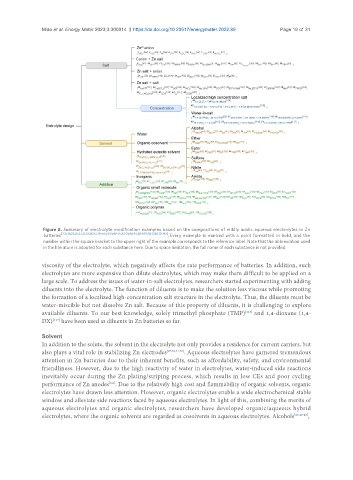
                Figure 8. Summary of electrolyte modification examples based on the compositions of mildly acidic aqueous electrolytes in Zn
                batteries [3,17,18,23,25,27,31,33,36,37,39-50,59-61,69-75,83-91,94-97,98-109,112-126,130-167] . Every example is marked with a point formatted in bold, and the
                number within the square bracket to the upper right of the example corresponds to the reference label. Note that the abbreviation used
                in the literature is adopted for each substance here. Due to space limitation, the full name of each substance is not provided.

               viscosity of the electrolyte, which negatively affects the rate performance of batteries. In addition, such
               electrolytes are more expensive than dilute electrolytes, which may make them difficult to be applied on a
               large scale. To address the issues of water-in-salt electrolytes, researchers started experimenting with adding
               diluents into the electrolyte. The function of diluents is to make the solution less viscous while promoting
               the formation of a localized high-concentration salt structure in the electrolyte. Thus, the diluents must be
               water-miscible but not dissolve Zn salt. Because of this property of diluents, it is challenging to explore
                                                                                    [118]
               available diluents. To our best knowledge, solely trimethyl phosphate (TMP)  and 1,4-dioxane (1,4-
                   [119]
               DX)  have been used as diluents in Zn batteries so far.
               Solvent
               In addition to the solute, the solvent in the electrolyte not only provides a residence for current carriers, but
               also plays a vital role in stabilizing Zn electrodes [25,39,41,50] . Aqueous electrolytes have garnered tremendous
               attention in Zn batteries due to their inherent benefits, such as affordability, safety, and environmental
               friendliness. However, due to the high reactivity of water in electrolytes, water-induced side reactions
               inevitably occur during the Zn plating/striping process, which results in low CEs and poor cycling
               performance of Zn anodes . Due to the relatively high cost and flammability of organic solvents, organic
                                      [2,6]
               electrolytes have drawn less attention. However, organic electrolytes enable a wide electrochemical stable
               window and alleviate side reactions faced by aqueous electrolytes. In light of this, combining the merits of
               aqueous electrolytes and organic electrolytes, researchers have developed organic/aqueous hybrid
               electrolytes, where the organic solvents are regarded as cosolvents in aqueous electrolytes. Alcohols [27,40-45] ,

