


Page 35 - Read Online
P. 35
Miao et al. Energy Mater 2023;3:300014  https://dx.doi.org/10.20517/energymater.2022.89  Page 17 of 31


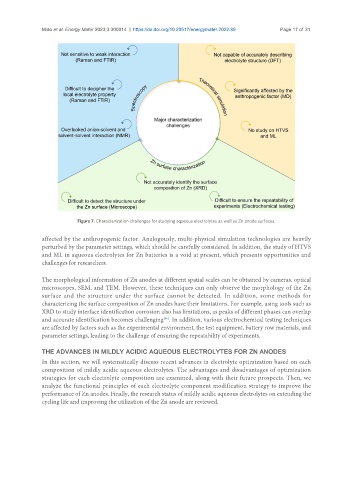
                           Figure 7. Characterization challenges for studying aqueous electrolytes as well as Zn anode surfaces.


               affected by the anthropogenic factor. Analogously, multi-physical simulation technologies are heavily
               perturbed by the parameter settings, which should be carefully considered. In addition, the study of HTVS
               and ML in aqueous electrolytes for Zn batteries is a void at present, which presents opportunities and
               challenges for researchers.


               The morphological information of Zn anodes at different spatial scales can be obtained by cameras, optical
               microscopes, SEM, and TEM. However, these techniques can only observe the morphology of the Zn
               surface and the structure under the surface cannot be detected. In addition, some methods for
               characterizing the surface composition of Zn anodes have their limitations. For example, using tools such as
               XRD to study interface identification corrosion also has limitations, as peaks of different phases can overlap
                                                        [86]
               and accurate identification becomes challenging . In addition, various electrochemical testing techniques
               are affected by factors such as the experimental environment, the test equipment, battery row materials, and
               parameter settings, leading to the challenge of ensuring the repeatability of experiments.


               THE ADVANCES IN MILDLY ACIDIC AQUEOUS ELECTROLYTES FOR ZN ANODES
               In this section, we will systematically discuss recent advances in electrolyte optimization based on each
               composition of mildly acidic aqueous electrolytes. The advantages and disadvantages of optimization
               strategies for each electrolyte composition are examined, along with their future prospects. Then, we
               analyze the functional principles of each electrolyte component modification strategy to improve the
               performance of Zn anodes. Finally, the research status of mildly acidic aqueous electrolytes on extending the
               cycling life and improving the utilization of the Zn anode are reviewed.

