


Page 26 - Read Online
P. 26
Page 8 of 31              Miao et al. Energy Mater 2023;3:300014  https://dx.doi.org/10.20517/energymater.2022.89


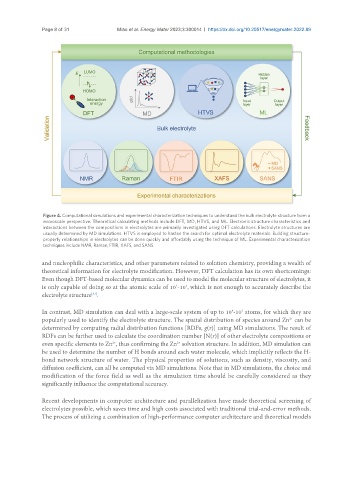
                Figure 4. Computational simulations and experimental characterization techniques to understand the bulk electrolyte structure from a
                microscale perspective. Theoretical calculating methods include DFT, MD, HTVS, and ML. Electronic structure characteristics and
                interactions between the compositions in electrolytes are primarily investigated using DFT calculations. Electrolyte structures are
                usually determined by MD simulations. HTVS is employed to hasten the search for optimal electrolyte materials. Building structure-
                property relationships in electrolytes can be done quickly and affordably using the technique of ML. Experimental characterization
                techniques include NMR, Raman, FTIR, XAFS, and SANS.

               and nucleophilic characteristics, and other parameters related to solution chemistry, providing a wealth of
               theoretical information for electrolyte modification. However, DFT calculation has its own shortcomings:
               Even though DFT-based molecular dynamics can be used to model the molecular structure of electrolytes, it
                                                            2
                                                                5
               is only capable of doing so at the atomic scale of 10 -10 , which is not enough to accurately describe the
               electrolyte structure .
                                [32]
                                                                                  5
                                                                               4
               In contrast, MD simulation can deal with a large-scale system of up to 10 -10  atoms, for which they are
               popularly used to identify the electrolyte structure. The spatial distribution of species around Zn  can be
                                                                                                   2+
               determined by computing radial distribution functions [RDFs, g(r)] using MD simulations. The result of
               RDFs can be further used to calculate the coordination number [N(r)] of other electrolyte compositions or
               even specific elements to Zn , thus confirming the Zn  solvation structure. In addition, MD simulation can
                                       2+
                                                             2+
               be used to determine the number of H bonds around each water molecule, which implicitly reflects the H-
               bond network structure of water. The physical properties of solutions, such as density, viscosity, and
               diffusion coefficient, can all be computed via MD simulations. Note that in MD simulations, the choice and
               modification of the force field as well as the simulation time should be carefully considered as they
               significantly influence the computational accuracy.


               Recent developments in computer architecture and parallelization have made theoretical screening of
               electrolytes possible, which saves time and high costs associated with traditional trial-and-error methods.
               The process of utilizing a combination of high-performance computer architecture and theoretical models

