


Page 24 - Read Online
P. 24
Page 6 of 31              Miao et al. Energy Mater 2023;3:300014  https://dx.doi.org/10.20517/energymater.2022.89


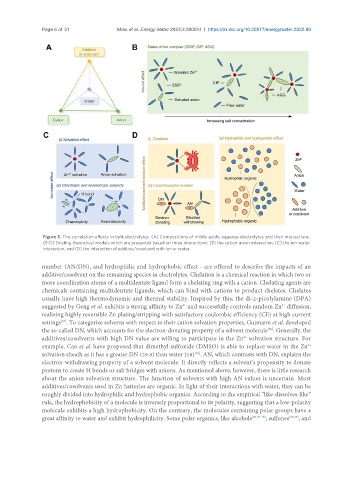
                Figure 3. The correlation effects in bulk electrolytes. (A) Compositions of mildly acidic aqueous electrolytes and their interactions.
                (B-D) Existing theoretical models which are presented based on three interactions: (B) the cation-anion interaction, (C) the ion-water
                interaction, and (D) the interaction of additive/cosolvent with ion or water.

               number (AN/DN), and hydrophilic and hydrophobic effect - are offered to describe the impacts of an
               additive/cosolvent on the remaining species in electrolytes. Chelation is a chemical reaction in which two or
               more coordination atoms of a multidentate ligand form a chelating ring with a cation. Chelating agents are
               chemicals containing multidentate ligands, which can bind with cations to product chelates. Chelates
               usually have high thermodynamic and thermal stability. Inspired by this, the di-2-picolylamine (DPA)
               suggested by Geng et al. exhibits a strong affinity to Zn  and successfully controls random Zn  diffusion,
                                                               2+
                                                                                                2+
               realizing highly reversible Zn plating/stripping with satisfactory coulombic efficiency (CE) at high current
               settings . To categorize solvents with respect to their cation solvation properties, Gutmann et al. developed
                      [37]
                                                                                           [38]
               the so-called DN, which accounts for the electron-donating property of a solvent molecule . Generally, the
                                                                                   2+
               additives/cosolvents with high DN value are willing to participate in the Zn  solvation structure. For
               example, Cao et al. have proposed that dimethyl sulfoxide (DMSO) is able to replace water in the Zn
                                                                                                         2+
               solvation sheath as it has a greater DN (29.8) than water (18) . AN, which contrasts with DN, explains the
                                                                   [39]
               electron-withdrawing property of a solvent molecule. It directly reflects a solvent’s propensity to donate
               protons to create H bonds or salt bridges with anions. As mentioned above, however, there is little research
               about the anion solvation structure. The function of solvents with high AN values is uncertain. Most
               additives/cosolvents used in Zn batteries are organic. In light of their interactions with water, they can be
               roughly divided into hydrophilic and hydrophobic organics. According to the empirical “like-dissolves-like”
               rule, the hydrophobicity of a molecule is inversely proportional to its polarity, suggesting that a low-polarity
               molecule exhibits a high hydrophobicity. On the contrary, the molecules containing polar groups have a
               great affinity to water and exhibit hydrophilicity. Some polar organics, like alcohols [27,40-45] , sulfones [39,46] , and

