


Page 21 - Read Online
P. 21
Miao et al. Energy Mater 2023;3:300014  https://dx.doi.org/10.20517/energymater.2022.89  Page 3 of 31


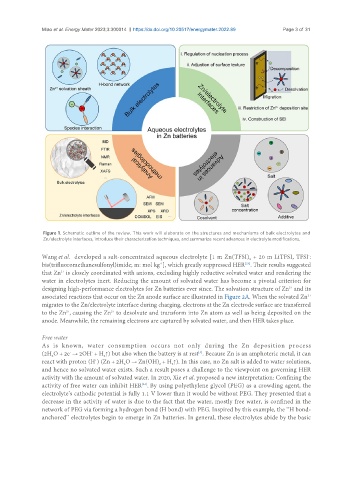
                Figure 1. Schematic outline of the review. This work will elaborate on the structures and mechanisms of bulk electrolytes and
                Zn/electrolyte interfaces, introduce their characterization techniques, and summarize recent advances in electrolyte modifications.

                                                                                                         -
               Wang et al.  developed a salt-concentrated aqueous electrolyte [1 m Zn(TFSI)  + 20 m LiTFSI, TFSI :
                                                                                     2
               bis(trifluoromethanesulfonyl)imide; m: mol kg ], which greatly suppressed HER . Their results suggested
                                                       -1
                                                                                    [23]
               that Zn  is closely coordinated with anions, excluding highly reductive solvated water and rendering the
                      2+
               water in electrolytes inert. Reducing the amount of solvated water has become a pivotal criterion for
               designing high-performance electrolytes for Zn batteries ever since. The solvation structure of Zn  and its
                                                                                                  2+
               associated reactions that occur on the Zn anode surface are illustrated in Figure 2A. When the solvated Zn
                                                                                                         2+
               migrates to the Zn/electrolyte interface during charging, electrons at the Zn electrode surface are transferred
               to the Zn , causing the Zn  to desolvate and transform into Zn atom as well as being deposited on the
                       2+
                                      2+
               anode. Meanwhile, the remaining electrons are captured by solvated water, and then HER takes place.
               Free water
               As  is  known,  water  consumption  occurs  not  only  during  the  Zn  deposition  process
                                                                    [4]
                                -
                         -
               (2H O + 2e  → 2OH  + H ↑) but also when the battery is at rest . Because Zn is an amphoteric metal, it can
                                    2
                  2
               react with proton (H ) (Zn + 2H O → Zn(OH)  + H ↑). In this case, no Zn salt is added to water solutions,
                                 +
                                                       2
                                                           2
                                           2
               and hence no solvated water exists. Such a result poses a challenge to the viewpoint on governing HER
               activity with the amount of solvated water. In 2020, Xie et al. proposed a new interpretation: Confining the
               activity of free water can inhibit HER . By using polyethylene glycol (PEG) as a crowding agent, the
                                                 [24]
               electrolyte’s cathodic potential is fully 1.1 V lower than it would be without PEG. They presented that a
               decrease in the activity of water is due to the fact that the water, mostly free water, is confined in the
               network of PEG via forming a hydrogen bond (H bond) with PEG. Inspired by this example, the ‘‘H bond-
               anchored’’ electrolytes begin to emerge in Zn batteries. In general, these electrolytes abide by the basic

