


Page 119 - Read Online
P. 119
Page 8 of 12               Cui et al. Energy Mater 2023;3:300034  https://dx.doi.org/10.20517/energymater.2023.19


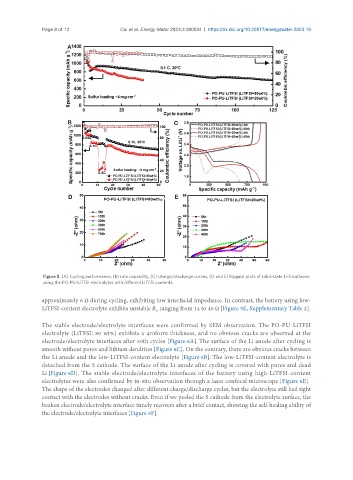
                Figure 5. (A) Cycling performance, (B) rate capability, (C) charge/discharge curves, (D and E) Nyquist plots of solid-state Li-S batteries
                using the PO-PU-LiTFSI electrolytes with different LiTFSI contents.

               approximately 6 Ω during cycling, exhibiting low interfacial impedance. In contrast, the battery using low-
               LiTFSI-content electrolyte exhibits unstable R  ranging from 14 to 46 Ω [Figure 5E, Supplementary Table 2].
                                                      ct

               The stable electrode/electrolyte interfaces were confirmed by SEM observation. The PO-PU-LiTFSI
               electrolyte (LiTFSI: 80 wt%) exhibits a uniform thickness, and no obvious cracks are observed at the
               electrode/electrolyte interfaces after 50th cycles [Figure 6A]. The surface of the Li anode after cycling is
               smooth without pores and lithium dendrites [Figure 6C]. On the contrary, there are obvious cracks between
               the Li anode and the low-LiTFSI-content electrolyte [Figure 6B]. The low-LiTFSI-content electrolyte is
               detached from the S cathode. The surface of the Li anode after cycling is covered with pores and dead
               Li [Figure 6D]. The stable electrode/electrolyte interfaces of the battery using high-LiTFSI-content
               electrolytes were also confirmed by in-situ observation through a laser confocal microscope [Figure 6E].
               The shape of the electrodes changed after different charge/discharge cycles, but the electrolyte still had tight
               contact with the electrodes without cracks. Even if we peeled the S cathode from the electrolyte surface, the
               broken electrode/electrolyte interface timely recovers after a brief contact, showing the self-healing ability of
               the electrode/electrolyte interfaces [Figure 6F].

