


Page 117 - Read Online
P. 117
Page 6 of 12               Cui et al. Energy Mater 2023;3:300034  https://dx.doi.org/10.20517/energymater.2023.19


                                              +
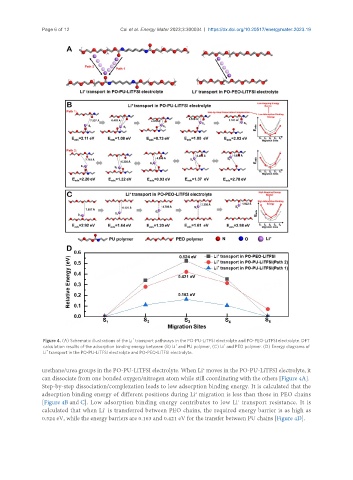
                Figure 4. (A) Schematic illustrations of the Li  transport pathways in the PO-PU-LiTFSI electrolyte and PO-PEO-LiTFSI electrolyte. DFT
                                                                            +
                                                            +
                calculation results of the adsorption binding energy between (B) Li  and PU polymer, (C) Li  and PEO polymer. (D) Energy diagrams of
                 +
                Li  transport in the PO-PU-LiTFSI electrolyte and PO-PEO-LiTFSI electrolyte.
               urethane/urea groups in the PO-PU-LiTFSI electrolyte. When Li  moves in the PO-PU-LiTFSI electrolyte, it
                                                                     +
               can dissociate from one bonded oxygen/nitrogen atom while still coordinating with the others [Figure 4A].
               Step-by-step dissociation/complexation leads to low adsorption binding energy. It is calculated that the
               adsorption binding energy of different positions during Li  migration is less than those in PEO chains
                                                                   +
               [Figure 4B and C]. Low adsorption binding energy contributes to low Li  transport resistance. It is
                                                                                 +
               calculated that when Li  is transferred between PEO chains, the required energy barrier is as high as
                                    +
               0.524 eV, while the energy barriers are 0.163 and 0.421 eV for the transfer between PU chains [Figure 4D].

