


Page 114 - Read Online
P. 114
Cui et al. Energy Mater 2023;3:300034  https://dx.doi.org/10.20517/energymater.2023.19  Page 3 of 12


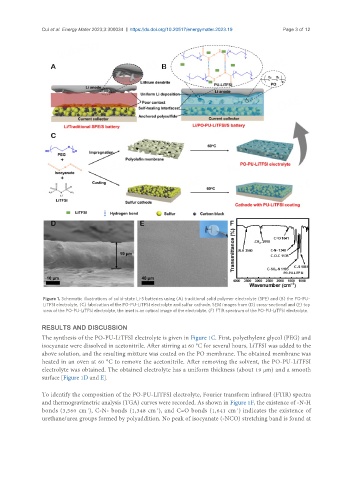
                Figure 1. Schematic illustrations of solid-state Li-S batteries using (A) traditional solid polymer electrolyte (SPE) and (B) the PO-PU-
                LiTFSI electrolyte, (C) fabrication of the PO-PU-LiTFSI electrolyte and sulfur cathode. SEM images from (D) cross-sectional and (E) top
                view of the PO-PU-LiTFSI electrolyte, the inset is an optical image of the electrolyte. (F) FTIR spectrum of the PO-PU-LiTFSI electrolyte.

               RESULTS AND DISCUSSION
               The synthesis of the PO-PU-LiTFSI electrolyte is given in Figure 1C. First, polyethylene glycol (PEG) and
               isocyanate were dissolved in acetonitrile. After stirring at 60 °C for several hours, LiTFSI was added to the
               above solution, and the resulting mixture was coated on the PO membrane. The obtained membrane was
               heated in an oven at 60 °C to remove the acetonitrile. After removing the solvent, the PO-PU-LiTFSI
               electrolyte was obtained. The obtained electrolyte has a uniform thickness (about 19 μm) and a smooth
               surface [Figure 1D and E].

               To identify the composition of the PO-PU-LITFSI electrolyte, Fourier transform infrared (FTIR) spectra
               and thermogravimetric analysis (TGA) curves were recorded. As shown in Figure 1F, the existence of -N-H
               bonds (3,560 cm ), C-N- bonds (1,348 cm ), and C=O bonds (1,641 cm ) indicates the existence of
                                                      -1
                              -1
                                                                                 -1
               urethane/urea groups formed by polyaddition. No peak of isocyanate (-NCO) stretching band is found at

