


Page 51 - Read Online
P. 51
Page 10 of 14                                                  Yu et al. Energy Mater. 2026, 6, 600044


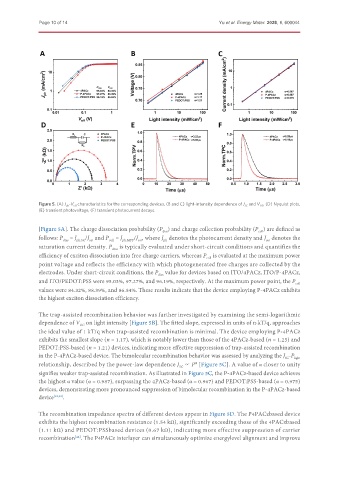
               Figure 5. (A) J ph -V eff  characteristics for the corresponding devices, (B and C) light-intensity dependence of J SC  and V OC , (D) Nyquist plots,
               (E) transient photovoltage, (F) transient photocurrent decays.

               [Figure 5A]. The charge dissociation probability (P ) and charge collection probability (P ) are defined as
                                                                                            coll
                                                          diss
               follows: P  = J ph,SC /J  and P  = J ph,MPP /J , where J  denotes the photocurrent density and J  denotes the
                                       coll
                       diss
                                                          ph
                                sat
                                                  sat
                                                                                              sat
               saturation current density. P  is typically evaluated under short-circuit conditions and quantifies the
                                        diss
               efficiency of exciton dissociation into free charge carriers, whereas P  is evaluated at the maximum power
                                                                          coll
               point voltage and reflects the efficiency with which photogenerated free charges are collected by the
               electrodes. Under short-circuit conditions, the P  value for devices based on ITO/4PACz, ITO/P-4PACz,
                                                         diss
               and ITO/PEDOT:PSS were 95.03%, 97.27%, and 96.19%, respectively. At the maximum power point, the P coll
               values were 84.32%, 88.39%, and 86.84%. These results indicate that the device employing P-4PACz exhibits
               the highest exciton dissociation efficiency.
               The trap-assisted recombination behavior was further investigated by examining the semi-logarithmic
               dependence of V  on light intensity [Figure 5B]. The fitted slope, expressed in units of n·kT/q, approaches
                             OC
               the ideal value of 1 kT/q when trap-assisted recombination is minimal. The device employing P-4PACz
               exhibits the smallest slope (n = 1.17), which is notably lower than those of the 4PACz-based (n = 1.25) and
               PEDOT:PSS-based (n = 1.21) devices, indicating more effective suppression of trap-assisted recombination
               in the P-4PACz-based device. The bimolecular recombination behavior was assessed by analyzing the J -P light
                                                                                                     SC
               relationship, described by the power-law dependence J  ∝ P  [Figure 5C]. A value of α closer to unity
                                                                      α
                                                                SC
               signifies weaker trap-assisted recombination. As illustrated in Figure 5C, the P-4PACz-based device achieves
               the highest α value (α = 0.987), surpassing the 4PACz-based (α = 0.967) and PEDOT:PSS-based (α = 0.975)
               devices, demonstrating more pronounced suppression of bimolecular recombination in the P-4PACz-based
               device [42,43] .


               The recombination impedance spectra of different devices appear in Figure 5D. The P4PACzbased device
               exhibits the highest recombination resistance (1.54 kΩ), significantly exceeding those of the 4PACzbased
               (1.11 kΩ) and PEDOT:PSSbased devices (0.67 kΩ), indicating more effective suppression of carrier
               recombination . The P4PACz interlayer can simultaneously optimize energylevel alignment and improve
                           [44]

