


Page 56 - Read Online
P. 56
Article  |  Open Access

                                                  Energy Materials


                                          Dong et al. Energy Mater.  2026, 6, 600026       DOI:10.20517/energymater.2025.216


               Heterojunction interface cation substitution to
               enhance the performance of antimony selenide
               thin-film solar cells


               Xu Dong , Wenyun Deng , Yimin Zhi , Bangzhi Shen , Sheng Li , Cheng Tang , Meilin Lu , Sai Jiang ,
                                                                                  4
                                                                                            2,*
                                               2,#
                                    2,#
                                                             2
                      1,#
                                                                                                      2,*
                                                                      2
               Jianhua Qiu , LvZhou Li , Huafei Guo 1,2,* , Ningyi Yuan , Jianning Ding 1,*
                                                            3
                         2
                                   1
               Keywords:
               Antimony selenide,
               lanthanide element
               neodymium, ionic antisite
               diffusion, heterojunction
               interface, density functional
               theory
               Citation: Dong, X.;
               Deng, W.; Zhi, Y.; Shen, B.;
               Li, S.; Tang, C.; Lu, M.;
               Jiang, S.; Qiu, J.; Li, L.; Guo, H.;
               Yuan, N.; Ding, J.
               Heterojunction interface
               cation substitution to
               enhance the performance of
               antimony selenide thin-film
               solar cells. Energy Mater.
               2026, 6, 600026.    Abstract
               https://dx.doi.org/10.20517
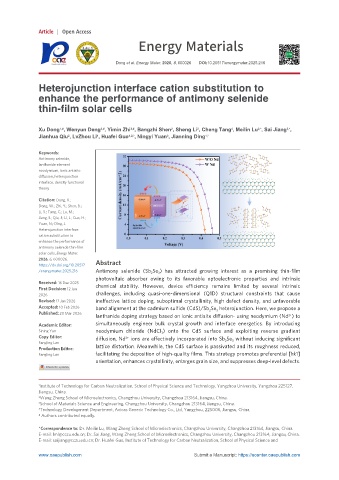
               /energymater.2025.216  Antimony   selenide   (Sb 2 Se 3 )   has   attracted   growing   interest   as   a   promising   thin-film
                                   photovoltaic   absorber   owing   to   its   favorable   optoelectronic   properties   and   intrinsic
               Received: 16 Dec 2025  chemical   stability.   However,   device   efficiency   remains   limited   by   several   intrinsic
               First Decision: 12 Jan
               2026                challenges,   including   quasi-one-dimensional   (Q1D)   structural   constraints   that   cause
               Revised: 17 Jan 2026  ineffective  lattice  doping,  suboptimal  crystallinity,  high  defect  density,  and  unfavorable
               Accepted: 10 Feb 2026  band alignment at the cadmium sulfide (CdS)/Sb 2 Se 3  heterojunction. Here, we propose a
               Published: 20 Mar 2026
                                   lanthanide doping strategy based on ionic antisite diffusion- using neodymium (Nd ) to
                                                                                                      3+
               Academic Editor:    simultaneously   engineer   bulk   crystal   growth   and   interface   energetics.   By   introducing
               Sining Yun          neodymium   chloride   (NdCl 3 )   onto   the   CdS   surface   and   exploiting   reverse   gradient
               Copy Editor:        diffusion,  Nd   ions  are  effectively  incorporated  into  Sb 2 Se 3   without  inducing  significant
                                             3+
               Fangling Lan
               Production Editor:  lattice distortion. Meanwhile, the CdS surface is passivated and its roughness reduced,
               Fangling Lan        facilitating the deposition of high-quality films. This strategy promotes preferential [hk1]
                                   orientation, enhances crystallinity, enlarges grain size, and suppresses deep-level defects.


               1 Institute of Technology for Carbon Neutralization, School of Physical Science and Technology, Yangzhou University, Yangzhou 225127,
               Jiangsu, China.
               2 Wang Zheng School of Microelectronics, Changzhou University, Changzhou 213164, Jiangsu, China.
               3 School of Materials Science and Engineering, Changzhou University, Changzhou 213164, Jiangsu, China.
               4 Technology Development Department, Avicas Generic Technology Co., Ltd, Yangzhou, 225006, Jiangsu, China.
               #  Authors contributed equally.
               *Correspondence to: Dr. Meilin Lu, Wang Zheng School of Microelectronics, Changzhou University, Changzhou 213164, Jiangsu, China.
               E-mail: lml@cczu.edu.cn; Dr. Sai Jiang, Wang Zheng School of Microelectronics, Changzhou University, Changzhou 213164, Jiangsu, China.
               E-mail: saijiang@cczu.edu.cn; Dr. Huafei Guo, Institute of Technology for Carbon Neutralization, School of Physical Science and

               www.oaepublish.com                                    Submit a Manuscript: https://ucenter.oaepublish.com

