


Page 49 - Read Online
P. 49
Page 8 of 14                                                   Yu et al. Energy Mater. 2026, 6, 600044


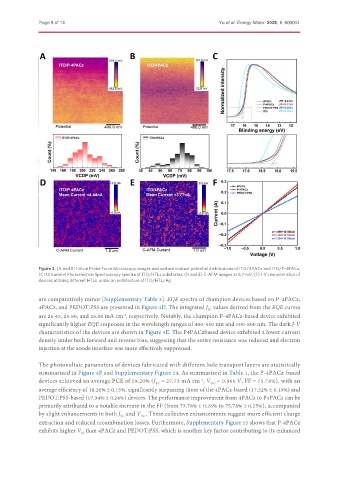
               Figure 3. (A and B) Kelvin Probe Force Microscopy images and surface contact potential distributions of ITO/4PACz and ITO/P-4PACz,
               (C) Ultraviolet Photoelectron Spectroscopy spectra of ITO/HTLs substrates, (D and E) C-AFM images at 8.7 mV, (F) I-V characteristics of
               devices utilizing different HTLs, under an architecture of ITO/HTL/Ag.

               are comparatively minor [Supplementary Table 3]. EQE spectra of champion devices based on P-4PACz,
               4PACz, and PEDOT:PSS are presented in Figure 4D. The integrated J  values derived from the EQE curves
                                                                          SC
               are 26.45, 25.90, and 25.00 mA cm , respectively. Notably, the champion P-4PACz-based device exhibited
                                            -2
               significantly higher EQE responses in the wavelength ranges of 400-450 nm and 500-800 nm. The dark J-V
               characteristics of the devices are shown in Figure 4E. The P4PACzbased device exhibited a lower current
               density under both forward and reverse bias, suggesting that the series resistance was reduced and electron
               injection at the anode interface was more effectively suppressed.


               The photovoltaic parameters of devices fabricated with different hole transport layers are statistically
               summarized in Figure 4F and Supplementary Figure 14. As summarized in Table 1, the P-4PACz-based
               devices achieved an average PCE of 18.20% (J  = 27.73 mA cm , V  = 0.866 V, FF = 75.78%), with an
                                                                       -2
                                                        SC
                                                                           OC
               average efficiency of 18.20% ± 0.15%, significantly surpassing those of the 4PACz-based (17.52% ± 0.19%) and
               PEDOT:PSS-based (17.34% ± 0.24%) devices. The performance improvement from 4PACz to P4PACz can be
               primarily attributed to a notable increase in the FF (from 73.78% ± 0.26% to 75.78% ± 0.25%), accompanied
               by slight enhancements in both J  and V . These collective enhancements suggest more efficient charge
                                                  OC
                                           SC
               extraction and reduced recombination losses. Furthermore, Supplementary Figure 15 shows that P-4PACz
               exhibits higher V  than 4PACz and PEDOT:PSS, which is another key factor contributing to its enhanced
                              bi

