


Page 50 - Read Online
P. 50
Yu et al. Energy Mater. 2026, 6, 600044                                           Page 9 of 14


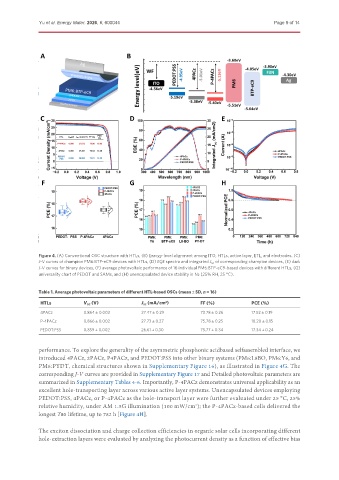
               Figure 4. (A) Conventional OSC structure with HTLs, (B) Energy-level alignment among ITO, HTLs, active layer, ETL, and electrodes. (C)
               J-V curves of champion PM6:BTP-eC9 devices with HTLs, (D) EQE spectra and integrated J SC  of corresponding champion devices, (E) dark
               J-V curves for binary devices, (F) average photovoltaic performance of 16 individual PM6:BTP-eC9-based devices with different HTLs, (G)
               universality chart of PEDOT and SAMs, and (H) unencapsulated device stability in N₂ (25% RH, 25 °C).

               Table 1. Average photovoltaic parameters of different HTL-based OSCs (mean ± SD, n = 16)

               HTLs           V OC  (V)            J SC  (mA/cm )      FF (%)            PCE (%)
                                                           2
               4PACz          0.864 ± 0.002        27.47 ± 0.29        73.78 ± 0.26      17.52 ± 0.19
               P-4PACz        0.866 ± 0.002        27.73 ± 0.27        75.78 ± 0.25      18.20 ± 0.15
               PEDOT:PSS      0.859 ± 0.002        26.61 ± 0.30        75.77 ± 0.34      17.34 ± 0.24


               performance. To explore the generality of the asymmetric phosphonic acidbased selfassembled interface, we
               introduced 4PACz, 2PACz, P4PACz, and PEDOT:PSS into other binary systems (PM6:L8BO, PM6:Y6, and
               PM6:PYDT, chemical structures shown in Supplementary Figure 16), as illustrated in Figure 4G. The
               corresponding J-V curves are provided in Supplementary Figure 17 and Detailed photovoltaic parameters are
               summarized in Supplementary Tables 4-6. Importantly, P-4PACz demonstrates universal applicability as an
               excellent hole-transporting layer across various active layer systems. Unencapsulated devices employing
               PEDOT:PSS, 4PACz, or P-4PACz as the hole-transport layer were further evaluated under 25 °C, 25%
               relative humidity, under AM 1.5G illumination (100 mW/cm ); the P-4PACz-based cells delivered the
                                                                      2
               longest T₈₀ lifetime, up to 782 h [Figure 4H].

               The exciton dissociation and charge collection efficiencies in organic solar cells incorporating different
               hole-extraction layers were evaluated by analyzing the photocurrent density as a function of effective bias

