


Page 46 - Read Online
P. 46
Yu et al. Energy Mater. 2026, 6, 600044                                           Page 5 of 14


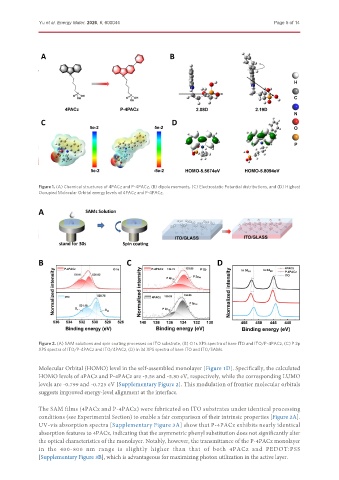
               Figure 1. (A) Chemical structures of 4PACz and P-4PACz, (B) dipole moments, (C) Electrostatic Potential distributions, and (D) Highest
               Occupied Molecular Orbital energy levels of 4PACz and P-4PACz.


               Figure 2. (A) SAM solutions and spin coating processes on ITO substrate, (B) O 1s XPS spectra of bare ITO and ITO/P-4PACz, (C) P 2p
               XPS spectra of ITO/P-4PACz and ITO/4PACz, (D) In 3d XPS spectra of bare ITO and ITO/SAMs.


               Molecular Orbital (HOMO) level in the self-assembled monolayer [Figure 1D]. Specifically, the calculated
               HOMO levels of 4PACz and P-4PACz are -5.56 and -5.80 eV, respectively, while the corresponding LUMO
               levels are -0.799 and -0.725 eV [Supplementary Figure 2]. This modulation of frontier molecular orbitals
               suggests improved energy-level alignment at the interface.

               The SAM films (4PACz and P-4PACz) were fabricated on ITO substrates under identical processing
               conditions (see Experimental Section) to enable a fair comparison of their intrinsic properties [Figure 2A].
               UV-vis absorption spectra [Supplementary Figure 3A] show that P-4PACz exhibits nearly identical
               absorption features to 4PACz, indicating that the asymmetric phenyl substitution does not significantly alter
               the optical characteristics of the monolayer. Notably, however, the transmittance of the P-4PACz monolayer
               in   the   400-800   nm   range   is   slightly   higher   than   that   of   both   4PACz   and   PEDOT:PSS
               [Supplementary Figure 3B], which is advantageous for maximizing photon utilization in the active layer.

