


Page 42 - Read Online
P. 42
Article  |  Open Access

                                            Energy Materials


                                     Yu et al. Energy Mater. 2026, 6, 600044      DOI:10.20517/energymater.2026.25


               Asymmetric carbazole-based self-assembled
               monolayers enable simultaneous efficiency and
               stability enhancement in organic solar cells


               Yangyang Yu , Xin Hong , Yuan Li , Zhengfei Wang , Feiyu Kang , Zhiwei Jiao , Guodan Wei 2,*
                                                                                 1,*
                                                          2
                                                                     2,*
                          1
                                            2
                                   2
               Keywords:
               Organic solar cells,
               self-assembled monolayer,
               asymmetric molecules, hole
               transport layer
               Citation: Yu, Y.; Hong, X.;
               Li, Y.; Wang, Z.; Kang, F.;
               Jiao, Z.; Wei, G. Asymmetric
               carbazole-based
               self-assembled monolayers
               enable simultaneous
               efficiency and stability
               enhancement in organic
               solar cells. Energy Mater.
               2026, 6, 600044.
               https://dx.doi.org/10.20517
               /energymater.2026.25
                                   Abstract
               Received: 20 Feb 2026
               First Decision: 12 Mar  Self-assembled monolayers (SAMs) have emerged as powerful interfacial modifiers for
               2026                high-performance   organic   solar   cells.   Currently   reported   asymmetric   substitution
               Revised: 28 Mar 2026  strategies have primarily focused on tuning molecular dipole moments and work functions
               Accepted: 16 Apr 2026  or enhancing π-π stacking to improve interfacial quality. In contrast, our work reports an
               Published: 6 May 2026
                                   asymmetric   carbazole-based   SAM   molecule,   P-4PACz,   featuring   a   unilateral   phenyl
               Academic Editor:    substituent at the 3-position of the carbazole core. This asymmetric design alters the π-π
               Sining Yun          stacking   mode   to   a   tightly   packed   yet   slipped   configuration,   which   enables   ordered
               Copy Editor:
               Fangling Lan        solid-state   assembly   while   suppressing   excessive   pre-aggregation   in   solution.   Such   an
               Production Editor:  approach   enables   a   favorable   balance   between   solution   processability   and   interfacial
               Fangling Lan        ordering.   Compared   with   its   symmetric   analogue   4PACz,   P-4PACz   exhibits   reduced
                                   surface   energy   on   indium   tin   oxide,   improved   energy-level   alignment,   and   suppressed
                                   molecular aggregation, resulting in enhanced active-layer wetting and interfacial contact.
                                   This   optimized   interface   promotes   efficient   hole   extraction   while   mitigating   interfacial
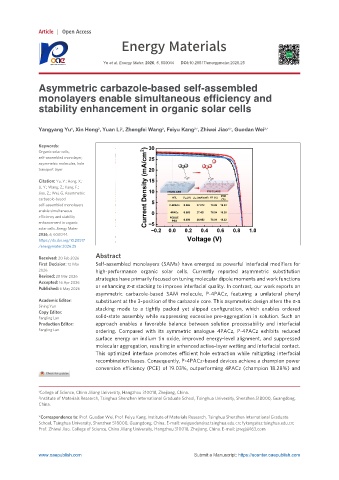
                                   recombination losses. Consequently, P-4PACz-based devices achieve a champion power
                                   conversion   efficiency   (PCE)   of   19.03%,   outperforming   4PACz   (champion   18.28%)   and


               1 College of Science, China Jiliang University, Hangzhou 310018, Zhejiang, China.
               2 Institute of Materials Research, Tsinghua Shenzhen International Graduate School, Tsinghua University, Shenzhen 518000, Guangdong,
               China.

               *Correspondence to: Prof. Guodan Wei, Prof. Feiyu Kang, Institute of Materials Research, Tsinghua Shenzhen International Graduate
               School, Tsinghua University, Shenzhen 518000, Guangdong, China. E-mail: weiguodan@sz.tsinghua.edu.cn; fykang@sz.tsinghua.edu.cn;
               Prof. Zhiwei Jiao, College of Science, China Jiliang University, Hangzhou 310018, Zhejiang, China. E-mail: jzwgj@163.com


               www.oaepublish.com                                    Submit a Manuscript: https://ucenter.oaepublish.com

