


Page 61 - 2417
P. 61
Page 14 of 22                                               François et al. Carbon Footprints 2026, 5, 22


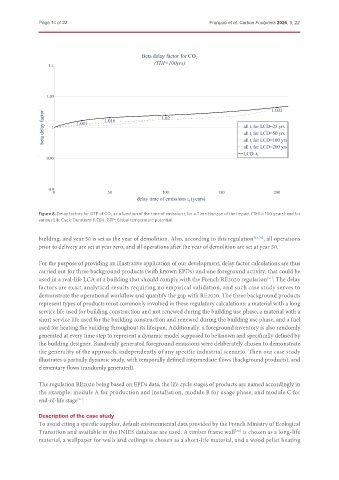
               Figure 8. Delay factors for GTP of CO 2  as a function of the time of emission t i  for a Time Horizon of the Impact (THI = 100 years) and for
               various Life Cycle Durations (LCD). GTP: Global temperature potential.

               building, and year 50 is set as the year of demolition. Also, according to this regulation [11,30] , all operations
               prior to delivery are set at year zero, and all operations after the year of demolition are set at year 50.


               For the purpose of providing an illustrative application of our development, delay factor calculations are thus
               carried out for three background products (with known EPDs) and one foreground activity, that could be
               used in a real-life LCA of a building that should comply with the French RE2020 regulation . The delay
                                                                                               [11]
               factors are exact analytical results requiring no empirical validation, and such case study serves to
               demonstrate the operational workflow and quantify the gap with RE2020. The three background products
               represent types of products most commonly involved in these regulatory calculations: a material with a long
               service life used for building construction and not renewed during the building use phase, a material with a
               short service life used for the building construction and renewed during the building use phase, and a fuel
               used for heating the building throughout its lifespan. Additionally, a foreground inventory is also randomly
               generated at every time step to represent a dynamic model supposed to be known and specifically defined by
               the building designer. Randomly generated foreground emissions were deliberately chosen to demonstrate
               the generality of the approach, independently of any specific industrial scenario. Then our case study
               illustrates a partially dynamic study, with temporally defined intermediate flows (background products), and
               elementary flows (randomly generated).

               The regulation RE2020 being based on EPDs data, the life cycle stages of products are named accordingly in
               the example: module A for production and installation, module B for usage phase, and module C for
               end-of-life stage .
                            [31]
               Description of the case study
               To avoid citing a specific supplier, default environmental data provided by the French Ministry of Ecological
               Transition and available in the INIES database are used. A timber frame wall  is chosen as a long-life
                                                                                    [32]
               material, a wallpaper for walls and ceilings is chosen as a short-life material, and a wood pellet heating

