


Page 68 - Read online
P. 68
Original Article  |  Open Access

                                          Carbon Footprints


                                         Cui et al. Carbon Footprints 2026, 5, 19      DOI:10.20517/cf.2026.03


               Soil inorganic carbon loss offsets organic carbon
               sequestration in cropland


               Bin Cui, Xiyan Tang, Jie Ma, Lishan Kuang, Ning Yuan, Fanqiao Meng

               Keywords:
               Long-term experiment,
               intensive farming, carbon
               conversion efficiency, deep
               soil, North China Plain

               Citation: Cui, B.; Tang, X.;
               Ma, J.; Kuang, L.; Yuan, N.;
               Meng, F. Soil inorganic
               carbon loss offsets organic
               carbon sequestration in
               cropland. Carbon Footprints
               2026, 5, 19.
               https://dx.doi.org/10.20517
               /cf.2026.03

               Received: 9 Jan 2026
               First Decision: 10 Feb
               2026                Abstract
               Revised: 3 Mar 2026
               Accepted: 17 Mar 2026  Agricultural  soils  are  vital  for  reducing  atmospheric  CO 2 ;  however,  the  effectiveness  of
               Published: 10 Apr 2026  farmland carbon sequestration, including soil organic carbon (SOC) and inorganic carbon
                                   (SIC), typically requires a lengthy period and varies with different farming practices. In a
               Academic Editor:
               Dafeng Hui          long-term study on the North China Plain, SOC and SIC changes due to farming practices
               Copy Editor:        involving  N  fertilization,  organic  materials,  irrigation,  and  no-tillage  were  tracked.  Four
               Ping Zhang          experimental treatments, including no N fertilizer input (CK), local farmer operation (FRM),
               Production Editor:  optimized farming (OPT), and no-tillage (NoT), were selected for the study. From 2008 to
               Ping Zhang
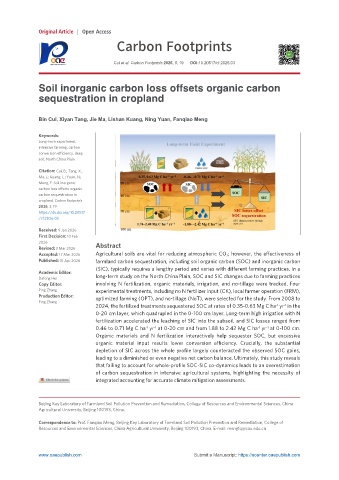
                                   2024, the fertilized treatments sequestered SOC at rates of 0.35-0.63 Mg C ha  yr  in the
                                                                                                  -1
                                                                                                     -1
                                   0-20 cm layer, which quadrupled in the 0-100 cm layer. Long-term high irrigation with N
                                   fertilization accelerated the leaching of SIC into the subsoil, and SIC losses ranged from
                                   0.46 to 0.71 Mg C ha  yr  at 0-20 cm and from 1.88 to 2.42 Mg C ha  yr  at 0-100 cm.
                                                                                            -1
                                                    -1
                                                       -1
                                                                                               -1
                                   Organic   materials   and   N   fertilization   interactively   help   sequester   SOC,   but   excessive
                                   organic   material   input   results   lower   conversion   efficiency.   Crucially,   the   substantial
                                   depletion of SIC across the whole profile largely counteracted the observed SOC gains,
                                   leading to a diminished or even negative net carbon balance. Ultimately, this study reveals
                                   that failing to account for whole-profile SOC-SIC co-dynamics leads to an overestimation
                                   of   carbon   sequestration   in   intensive   agricultural   systems,   highlighting   the   necessity   of
                                   integrated accounting for accurate climate mitigation assessments.


               Beijing Key Laboratory of Farmland Soil Pollution Prevention and Remediation, College of Resources and Environmental Sciences, China
               Agricultural University, Beijing 100193, China.

               Correspondence to: Prof. Fanqiao Meng, Beijing Key Laboratory of Farmland Soil Pollution Prevention and Remediation, College of
               Resources and Environmental Sciences, China Agricultural University, Beijing 100193, China. E-mail: mengfq@cau.edu.cn


               www.oaepublish.com                                    Submit a Manuscript: https://ucenter.oaepublish.com

