


Page 36 - Read online
P. 36
Artyukhov et al. Carbon Footprints 2026, 5, 8                                    Page 13 of 21


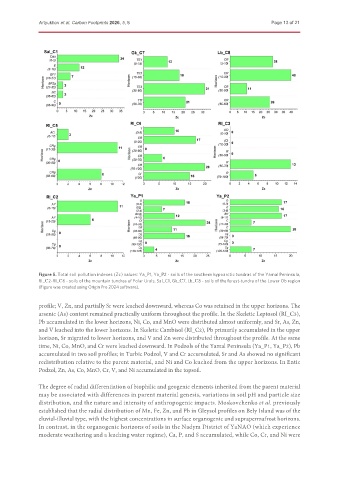
               Figure 5. Total soil pollution indexes (Zc) values: Ya_Р1, Ya_Р2 - soils of the southern hypoarctic tundras of the Yamal Peninsula,
               RI_С2-RI_С6 - soils of the mountain tundras of Polar Urals, Sal_C1, Gk_С7, Lb_С8 - soils of the forest-tundra of the Lower Ob region
               (Figure was created using Origin Pro 2024 software).


               profile; V, Zn, and partially Sr were leached downward, whereas Co was retained in the upper horizons. The
               arsenic (As) content remained practically uniform throughout the profile. In the Skeletic Leptosol (RI_C3),
               Pb accumulated in the lower horizons, Ni, Co, and MnO were distributed almost uniformly, and Sr, As, Zn,
               and V leached into the lower horizons. In Skeletic Cambisol (RI_C2), Pb primarily accumulated in the upper
               horizon, Sr migrated to lower horizons, and V and Zn were distributed throughout the profile. At the same
               time, Ni, Co, MnO, and Cr were leached downward. In Podzols of the Yamal Peninsula (Ya_P1, Ya_P2), Pb
               accumulated in two soil profiles; in Turbic Podzol, V and Cr accumulated, Sr and As showed no significant
               redistribution relative to the parent material, and Ni and Co leached from the upper horizons. In Entic
               Podzol, Zn, As, Co, MnO, Cr, V, and Ni accumulated in the topsoil.


               The degree of radial differentiation of biophilic and geogenic elements inherited from the parent material
               may be associated with differences in parent material genesis, variations in soil pH and particle size
               distribution, and the nature and intensity of anthropogenic impacts. Moskovchenko et al. previously
               established that the radial distribution of Mn, Fe, Zn, and Pb in Gleysol profiles on Bely Island was of the
               eluvial-illuvial type, with the highest concentrations in surface organogenic and suprapermafrost horizons.
               In contrast, in the organogenic horizons of soils in the Nadym District of YaNAO (which experience
               moderate weathering and a leaching water regime), Ca, P, and S accumulated, while Co, Cr, and Ni were

