


Page 39 - Read online
P. 39
Page 16 of 21                                              Artyukhov et al. Carbon Footprints 2026, 5, 8


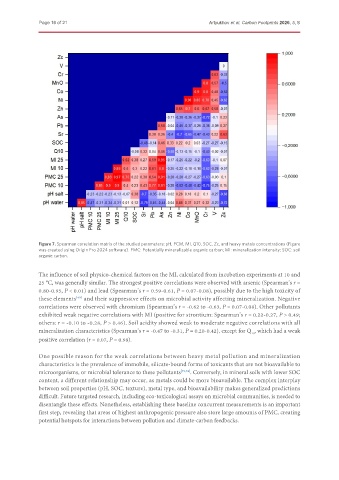
               Figure 7. Spearman correlation matrix of the studied parameters: pH, PCM, MI, Q10, SOC, Zc, and heavy metals concentrations (Figure
               was created using Origin Pro 2024 software). PMC: Potentially mineralizable organic carbon; MI: mineralization intensity; SOC: soil
               organic carbon.

               The influence of soil physico-chemical factors on the MI, calculated from incubation experiments at 10 and
               25 °C, was generally similar. The strongest positive correlations were observed with arsenic (Spearman’s r =
               0.80-0.95, P < 0.01) and lead (Spearman’s r = 0.59-0.61, P = 0.07-0.08), possibly due to the high toxicity of
               these elements  and their suppressive effects on microbial activity affecting mineralization. Negative
                            [68]
               correlations were observed with chromium (Spearman’s r = -0.62 to -0.63, P = 0.07-0.08). Other pollutants
               exhibited weak negative correlations with MI (positive for strontium: Spearman’s r = 0.22-0.27, P > 0.49;
               others: r = -0.10 to -0.28, P > 0.46). Soil acidity showed weak to moderate negative correlations with all
               mineralization characteristics (Spearman’s r = -0.47 to -0.31, P = 0.20-0.42), except for Q , which had a weak
                                                                                         10
               positive correlation (r = 0.07, P = 0.98).


               One possible reason for the weak correlations between heavy metal pollution and mineralization
               characteristics is the prevalence of immobile, silicate-bound forms of toxicants that are not bioavailable to
               microorganisms, or microbial tolerance to these pollutants [73,74] . Conversely, in mineral soils with lower SOC
               content, a different relationship may occur, as metals could be more bioavailable. The complex interplay
               between soil properties (pH, SOC, texture), metal type, and bioavailability makes generalized predictions
               difficult. Future targeted research, including eco-toxicological assays on microbial communities, is needed to
               disentangle these effects. Nonetheless, establishing these baseline concurrent measurements is an important
               first step, revealing that areas of highest anthropogenic pressure also store large amounts of PMC, creating
               potential hotspots for interactions between pollution and climate-carbon feedbacks.

