


Page 73 - Read Online
P. 73
Page 6 of 16                       Hu et al. Carbon Footprints 2024;3:16  https://dx.doi.org/10.20517/cf.2024.28

               applicable in this context, as it highlights the indirect effects of policy interventions, which are crucial for
               capturing the complexity of emissions reduction. This study considers city industrial structure,
               hypothesizing that industrial parks affect carbon emission intensity by inducing changes in industrial
                                                                                  [28]
               structure. Based on the availability of data and with reference to other studies , this paper takes the city
               industrial structure as the mediating variable, with an underlying hypothesis that the establishment of
               relevant industrial parks would indirectly affect city carbon emission intensity via the industrial structure.
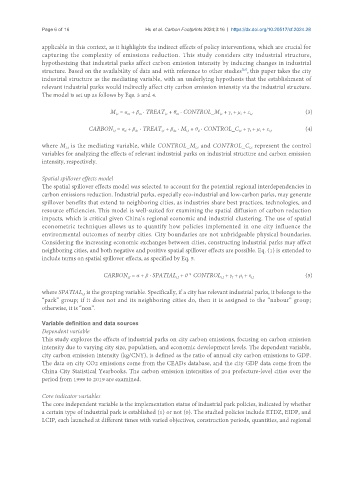
               The model is set up as follows by Eqs. 3 and 4.


                                      M  = α  + β  · TREAT  + θ  · CONTROL_M  + γ + μ + ε                                     (3)
                                                            m
                                            m
                                                m
                                                         i,t
                                                                                  i
                                        i,t
                                                                               t
                                                                           i,t
                                                                                     i,t
                               CARBON  = α  + β  · TREAT  + β  · M  + θ  · CONTROL_C  + γ + μ + ε                        (4)
                                       i,t
                                                                                     t
                                                                                            i,t
                                                                                         i
                                                                i,t
                                                                    d
                                                                                  i,t
                                                           d2
                                           d
                                               d1
                                                       i,t
               where M  is the mediating variable, while CONTROL_M  and CONTROL_C  represent the control
                                                                   i,t
                       i,t
                                                                                     i,t
               variables for analyzing the effects of relevant industrial parks on industrial structure and carbon emission
               intensity, respectively.
               Spatial spillover effects model
               The spatial spillover effects model was selected to account for the potential regional interdependencies in
               carbon emissions reduction. Industrial parks, especially eco-industrial and low-carbon parks, may generate
               spillover benefits that extend to neighboring cities, as industries share best practices, technologies, and
               resource efficiencies. This model is well-suited for examining the spatial diffusion of carbon reduction
               impacts, which is critical given China’s regional economic and industrial clustering. The use of spatial
               econometric techniques allows us to quantify how policies implemented in one city influence the
               environmental outcomes of nearby cities. City boundaries are not unbridgeable physical boundaries.
               Considering the increasing economic exchanges between cities, constructing industrial parks may affect
               neighboring cities, and both negative and positive spatial spillover effects are possible. Eq. (1) is extended to
               include terms on spatial spillover effects, as specified by Eq. 5.
                                    CARBON  = α + β · SPATIAL  + θ * CONTROL  + γ + μ + ε                                    (5)
                                                                                   i
                                                                            i,t
                                                                               t
                                                                                      i,t
                                                            i,t
                                            i,t
               where SPATIAL  is the grouping variable. Specifically, if a city has relevant industrial parks, it belongs to the
                             i,t
               “park” group; if it does not and its neighboring cities do, then it is assigned to the “nabour” group;
               otherwise, it is “non”.
               Variable definition and data sources
               Dependent variable
               This study explores the effects of industrial parks on city carbon emissions, focusing on carbon emission
               intensity due to varying city size, population, and economic development levels. The dependent variable,
               city carbon emission intensity (kg/CNY), is defined as the ratio of annual city carbon emissions to GDP.
               The data on city CO2 emissions come from the CEADs database, and the city GDP data come from the
               China City Statistical Yearbooks. The carbon emission intensities of 204 prefecture-level cities over the
               period from 1999 to 2019 are examined.
               Core indicator variables
               The core independent variable is the implementation status of industrial park policies, indicated by whether
               a certain type of industrial park is established (1) or not (0). The studied policies include ETDZ, EIDP, and
               LCIP, each launched at different times with varied objectives, construction periods, quantities, and regional

