


Page 24 - Read Online
P. 24
Page 6 of 17                      Zhen et al. Carbon Footprints 2024;3:7  https://dx.doi.org/10.20517/cf.2023.50

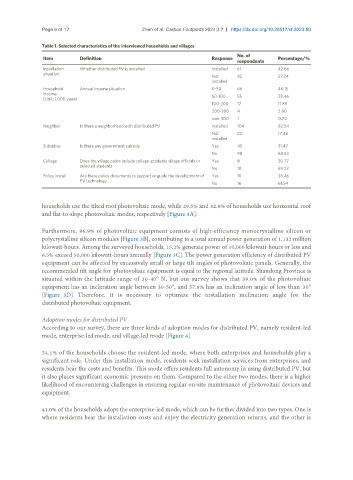
               Table 1. Selected characteristics of the interviewed households and villages
                                                                                 No. of
                Item        Definition                                  Response               Percentage/%
                                                                                 respondents
                Installation   Whether distributed PV is installed      Installed  61          42.66
                situation
                                                                        Not      82            57.34
                                                                        installed
                Household   Annual income situation                     0-50     66            46.15
                income
                                                                        50-100   55            38.46
                (Unit: 1,000 yuan)
                                                                        100-200  17            11.89
                                                                        200-300  4             2.80
                                                                        over 300  1            0.70
                Neighbor    Is there a neighborhood with distributed PV  Installed  104        82.54
                                                                        Not      22            17.46
                                                                        installed
                Subsidies   Is there any government subsidy             Yes      45            31.47
                                                                        No       98            68.53
                College     Does the village cadre include college-graduate village officials or   Yes  8  30.77
                            selected students
                                                                        No       18            69.23
                Policy install  Are there policy documents to support or guide the development of   Yes  10  38.46
                            PV technology
                                                                        No       16            61.54

               households use the tilted roof photovoltaic mode, while 29.5% and 32.8% of households use horizontal roof
               and flat-to-slope photovoltaic modes, respectively [Figure 3A].


               Furthermore, 86.9% of photovoltaic equipment consists of high-efficiency monocrystalline silicon or
               polycrystalline silicon modules [Figure 3B], contributing to a total annual power generation of 1.132 million
               kilowatt-hours. Among the surveyed households, 15.2% generate power of 10,000 kilowatt-hours or less and
               6.5% exceed 50,000 kilowatt-hours annually [Figure 3C]. The power generation efficiency of distributed PV
               equipment can be affected by excessively small or large tilt angles of photovoltaic panels. Generally, the
               recommended tilt angle for  photovoltaic equipment is equal to the regional latitude. Shandong Province is
               situated within the latitude range of 30-40° N, but our survey shows that 39.0% of the photovoltaic
               equipment has an inclination angle between 30-50°, and 57.6% has an inclination angle of less than 30°
               [Figure  3D].  Therefore,  it  is  necessary  to  optimize  the  installation  inclination  angle  for  the
               distributed photovoltaic equipment.

               Adoption modes for distributed PV
               According to our survey, there are three kinds of adoption modes for distributed PV, namely resident-led
               mode, enterprise-led mode, and village-led mode [Figure 4].

               54.1% of the households choose the resident-led mode, where both enterprises and households play a
               significant role. Under this installation mode, residents seek installation services from enterprises, and
               residents bear the costs and benefits. This mode offers residents full autonomy in using distributed PV, but
               it also places significant economic pressure on them. Compared to the other two modes, there is a higher
               likelihood of encountering challenges in ensuring regular on-site maintenance of photovoltaic devices and
               equipment.

               41.0% of the households adopt the enterprise-led mode, which can be further divided into two types. One is
               where residents bear the installation costs and enjoy the electricity generation returns, and the other is

