


Page 23 - Read Online
P. 23
Zhen et al. Carbon Footprints 2024;3:7  https://dx.doi.org/10.20517/cf.2023.50   Page 5 of 17

               questionnaire implementation. This expertise ensured the collection of high-quality data and information in
               our study. The survey was distributed to 158 farmers and 26 village committees across 14 cities and 36
               villages in Shandong Province. Of the 184 distributed questionnaires, 169 were valid (15 families did not
               complete the questionnaires).


               Model setting
               Logit regression uses a maximum likelihood approach to form a best-fit equation or function, which
               maximizes the probability that a given regression coefficient will classify the observations into the
                                 [32]
               appropriate category . In our research, the dependent variable (Install) is binary, representing the decision
               of the families about whether they install distributed PV or not. Thus, we apply the Logit model to analyze
               the decision of each family, which has been widely applied in analyzing the determinants of decision-
               making [33,34] .


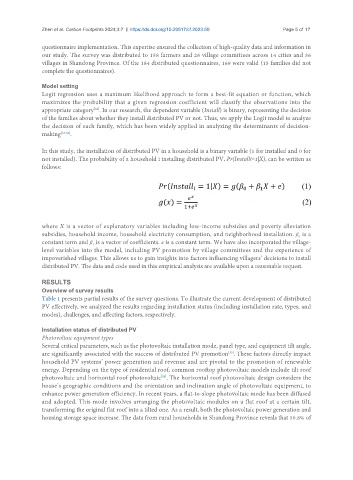
               In this study, the installation of distributed PV in a household is a binary variable (1 for installed and 0 for
               not installed). The probability of a household i installing distributed PV, Pr(Installi=1|X), can be written as
               follows:


               where X is a vector of explanatory variables including low-income subsidies and poverty alleviation
               subsidies, household income, household electricity consumption, and neighborhood installation. β  is a
                                                                                                      0
               constant term and β  is a vector of coefficients. e is a constant term. We have also incorporated the village-
                                1
               level variables into the model, including PV promotion by village committees and the experience of
               impoverished villages. This allows us to gain insights into factors influencing villagers’ decisions to install
               distributed PV. The data and code used in this empirical analysis are available upon a reasonable request.


               RESULTS
               Overview of survey results
               Table 1 presents partial results of the survey questions. To illustrate the current development of distributed
               PV effectively, we analyzed the results regarding installation status (including installation rate, types, and
               modes), challenges, and affecting factors, respectively.


               Installation status of distributed PV
               Photovoltaic equipment types
               Several critical parameters, such as the photovoltaic installation mode, panel type, and equipment tilt angle,
                                                                              [35]
               are significantly associated with the success of distributed PV promotion . These factors directly impact
               household PV systems’ power generation and revenue and are pivotal to the promotion of renewable
               energy. Depending on the type of residential roof, common rooftop photovoltaic models include tilt roof
               photovoltaic and horizontal roof photovoltaic . The horizontal roof photovoltaic design considers the
                                                       [36]
               house’s geographic conditions and the orientation and inclination angle of photovoltaic equipment, to
               enhance power generation efficiency. In recent years, a flat-to-slope photovoltaic mode has been diffused
               and adopted. This mode involves arranging the photovoltaic modules on a flat roof at a certain tilt,
               transforming the original flat roof into a tilted one. As a result, both the photovoltaic power generation and
               housing storage space increase. The data from rural households in Shandong Province reveals that 50.8% of

