


Page 28 - Read Online
P. 28
Page 10 of 17                     Zhen et al. Carbon Footprints 2024;3:7  https://dx.doi.org/10.20517/cf.2023.50

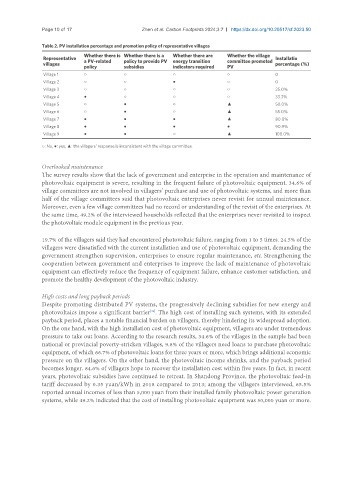
               Table 2. PV installation percentage and promotion policy of representative villages
                             Whether there is  Whether there is a   Whether there are   Whether the village
                Representative                                                                Installatio
                villages     a PV-related   policy to provide PV  energy transition   committee promoted   percentage (%)
                                                                              PV
                                                           indicators required
                             policy
                                           subsidies
                Village 1    ○             ○               ○                  ○               0
                Village 2    ○             ○               ●                  ○               0
                Village 3    ○             ○               ○                  ○               25.0%
                Village 4    ●             ○               ○                  ○               33.3%
                Village 5    ○             ●               ○                  ▲               50.0%
                Village 6    ○             ●               ○                  ▲               55.0%
                Village 7    ●             ●               ●                  ▲               80.0%
                Village 8    ●             ●               ●                  ●               90.9%
                Village 9    ●             ●               ○                  ▲               100.0%
               ○: No, ●: yes, ▲: the villagers’ response is inconsistent with the village committee.


               Overlooked maintenance
               The survey results show that the lack of government and enterprise in the operation and maintenance of
               photovoltaic equipment is severe, resulting in the frequent failure of photovoltaic equipment. 34.6% of
               village committees are not involved in villagers’ purchase and use of photovoltaic systems, and more than
               half of the village committees said that photovoltaic enterprises never revisit for annual maintenance.
               Moreover, even a few village committees had no record or understanding of the revisit of the enterprises. At
               the same time, 49.2% of the interviewed households reflected that the enterprises never revisited to inspect
               the photovoltaic module equipment in the previous year.


               19.7% of the villagers said they had encountered photovoltaic failure, ranging from 1 to 5 times. 24.5% of the
               villagers were dissatisfied with the current installation and use of photovoltaic equipment, demanding the
               government strengthen supervision, enterprises to ensure regular maintenance, etc. Strengthening the
               cooperation between government and enterprises to improve the lack of maintenance of photovoltaic
               equipment can effectively reduce the frequency of equipment failure, enhance customer satisfaction, and
               promote the healthy development of the photovoltaic industry.


               High costs and long payback periods
               Despite promoting distributed PV systems, the progressively declining subsidies for new energy and
               photovoltaics impose a significant barrier . The high cost of installing such systems, with its extended
                                                    [39]
               payback period, places a notable financial burden on villagers, thereby hindering its widespread adoption.
               On the one hand, with the high installation cost of photovoltaic equipment, villagers are under tremendous
               pressure to take out loans. According to the research results, 34.6% of the villages in the sample had been
               national or provincial poverty-stricken villages, 9.8% of the villagers need loans to purchase photovoltaic
               equipment, of which 66.7% of photovoltaic loans for three years or more, which brings additional economic
               pressure on the villagers. On the other hand, the photovoltaic income shrinks, and the payback period
               becomes longer. 84.6% of villagers hope to recover the installation cost within five years. In fact, in recent
               years, photovoltaic subsidies have continued to retreat. In Shandong Province, the photovoltaic feed-in
               tariff decreased by 0.35 yuan/kWh in 2018 compared to 2013; among the villagers interviewed, 65.5%
               reported annual incomes of less than 5,000 yuan from their installed family photovoltaic power generation
               systems, while 49.2% indicated that the cost of installing photovoltaic equipment was 50,000 yuan or more.

